

_page-0001_20260903101241.jpg)




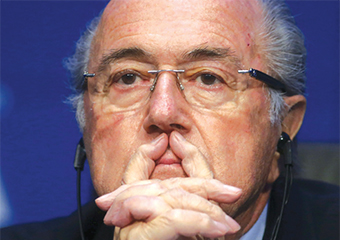
There have not been many people shouting out in support of FIFA’s returning president, Sepp Blatter, although clearly he must have some supporters given the overwhelming majority he returned in the election for the post.
The recent arrests and extradition of a number of the 18 executives named in an indictment issued by the US Department of Justice did little to assuage the support he has garnered over four terms in office. FIFA itself was quick to claim that this all forms part of the game’s governing body’s own attempts to enhance self-governance.
Having been elected for a fifth term, Blatter went on the offensive against the Americans and British media before Russian Premier Vladimir Putin lent his considerable backing … although he does have a vested interest with his country due to host the 2018 World Cup.
Yet, if you examine the voting patterns it becomes clear that Blatter has huge support in Africa and Asia where both regions are extremely grateful for the work that FIFA does in helping the local associations develop the game at the grassroots level, providing significant funding and expertise.
As World Cup revenues have escalated dramatically through global sponsorship arrangements and the sale of television rights, so have the development payments.
Is this therefore a case of the ‘haves’ versus the ‘have-nots’? UEFA executives have been complaining that they do not have the required leverage within FIFA that would serve the best interests of the beautiful game, effectively arguing that they deserve more than one vote each. Should the wealthier football nations be entitled to more than one vote? That would be absurd.
FIFA consists of 209 members (more than the United Nations) of which approximately two-thirds voted for Blatter demonstrating he knows his audience.
UEFA represents only 53 of these, yet it is believed that as many as 18 defied an instruction to vote for Prince Ali of Jordan, with pro-Qatar countries Spain and France understood to have been among the ‘dissenters’. This makes the prospects of a unilateral boycott unlikely.
Yet while corruption has reared its ugly head I cannot help but feel that this outrage is aimed at an attempt to revisit the votes that led to the award of the 2018 World Cup to Russia and 2022 to Qatar. It is true that approximately half of the original voting panel have now been indicted for corruption and the other half are under investigation. However, one of Blatter’s staunchest critics is Michel Platini, the head of UEFA – and he voted for Qatar!
Although I appreciate the mechanics of FIFA I still believe that Blatter should step down. The award of development funding will continue without him.
Simply, while no allegations of corruption have been pinned to him personally, he has run an organisation that has failed to act properly for many years in my opinion. What more could have been done with the so-called ‘bribes’ if they had been directed to grassroots football rather than allegedly the fat cats?


