

_page-0001_20260903101241.jpg)




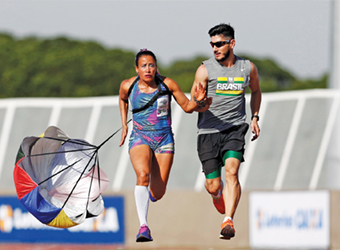
Conversations about the Olympics would not be complete without a discussion as to whether or not certain athletes or sports deserve to be there. Fortunately that is not the case with the Paralympics with the athletes attending Rio this week genuinely considering the competition to be the pinnacle of their careers.
It is a shame, therefore, that the Brazilian hosts have treated the Paralympics with such antipathy with a financial shortfall adversely impacting on the visiting teams.
An overspend on the Olympics in addition to sluggish ticket sales meant that several of the 165 countries were struggling to meet their travel costs to attend while Rio has even slashed the amount of local transportation available.
Sir Philip Craven, the president of the International Paralympic Committee, spoke out about what he referred to as the biggest crisis in the 56-year history of the event.
At least the IPC can be applauded for taking a firm stance by banning all Russian athletes on the back of their state-sponsored doping scandal, although this has led to more than 100 athletes lodging their individual appeals seeking re-admittance.
The hosts have started to stir from their apathy with ticket sales picking up as prices have been reduced to as little as $3 to allow fans to watch local stars from the London Olympics such as Alan Oliveira and Terezinha Guilhermina.
The Paralympics, first held in Rome in 1960, showcase the achievements of athletes with an impairment to a global audience and act as a primary vehicle to change societal perceptions, providing an opportunity to leave a lasting legacy.
They have moved on from the early days at which there were 400 athletes from 23 countries competing in 13 sports. London broke all records with more than 4,000 athletes competing across 20 sports while selling 2.7m tickets to spectators.
Triathlon, consisting of a 750m swim, 20km cycling (where tandem, hand-cycle or bicycle can be used) and 5km run (wheelchairs are permitted) and canoeing have been added to the Rio schedule that also includes the specialist sports of Boccia and Goalball.
Boccia is a game similar to bowling played indoors on a court similar in size to badminton where each side has to get their coloured balls closest to the white target ball (the jack).
Goalball is similar to handball but is played by the visually impaired and so the ball makes a noise when it is thrown or rolled.
Football is also represented in a five-a-side format for the visually-impaired and seven-a-side for those with cerebral palsy or have suffered a brain injury.
Athletics and swimming are the only two sports that cater for competitors from all physical impairment groups, visual impairments or those with a learning disability.
However, it is the classification of these impairments that can cause the greatest controversy with UK Athletics already promising a post-Paralympic enquiry after internal complaints have been received.
Dr Mukul Agarwal, a former medical officer for the GB Paralympics team, said: “I do have concerns about the way classification works currently and about the potential for cheating. Medical records are part of the classification system but there’s a degree of trust in what is offered to the classifiers. Should an athlete, coach, national governing body or a country choose not to present the entire data it is possible that an inaccurate classification could take place.”
The motto of the International Paralympic Committee is ‘to enable para-athletes to achieve sporting excellence and inspire and excite the world’.
The purpose of classification is to allow fair competition between people with different types of disability. Classification is governed by a code drawn up by the IPC, the world governing body for the sport.
The current code was drawn up in 2007 and will be replaced by a new code at the beginning of next year.
Classification is sport specific and is governed by different international sports federations, but the IPC code sets the framework for classification across sports.
A favourable classification can lead to athletes competing against those with a worse impairment, thereby boosting medal chances. One of the highest profile examples was at the 2000 Games when the gold-medal winning Spanish basketball team was stripped of medals after it was discovered that most of the players did not have the learning difficulties claimed.
However, setting that aside, the Paralympics are a wonderful spectacle as athletes demonstrate their ability to overcome the significant obstacles in their lives.
The US is expecting to obtain a record haul while GB is hoping to surpass the total they secured at home four years ago.
THE Bahrain delegation has left for Rio de Janeiro to take part in the Paralympic Games.
Bahrain will be represented by Fatima Abdel Razaq Safr and Ruba Al Amry from the Bahrain Disabled Sports Federation (BDSF).
The delegation includes the BDSF General Secretary, national coaches Yousif Saleh Al Riffai and Eman Hassan Jassim, as well as administrative staff member Sara Ibrahim Al Shawy.
The Bahrain delegation is ‘hopeful’ that the athletes will achieve success in the competitions.
The competitors had been training hard and following a special diet to help them reach their physical peak.
Safr is considered as the world’s top-ranked shot-putter by the International Paralympic Committee while Al Omary will participate in the discus throw after she bagged fourth spot in the qualifications.
Bahrain has claimed nine medals at the Paralympic Summer Games.
Seoul 1988 were Bahrain’s most successful Paralympic Games to date, winning its only gold medal. The nation is in 81st place on the Summer Games’ all-time medal table.
Khaled Al Sager won Bahrain’s only gold medal in the men’s slalom. He also claimed a silver medal in the men’s discus throw at the Barcelona 1992 Paralympic Games.
Adel Sultan is the only other multi-medallist for Bahrain at the Paralympic Games. He bagged bronze in 1984 in the men’s 100m and silver in 1988 in the men’s 100m.
But Bahrain failed to win a medal at the previous two Paralympic Games.
There is no rights holding broadcaster in Bahrain, but the Paralympic Games can be watched live via the IPC’s website at www.paralympic.org

