

_page-0001_20260903101241.jpg)




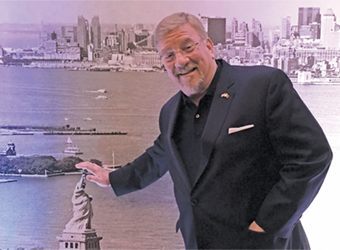
THE grandson of a former US president living in Bahrain believes a blast from the past may help solve some of the major issues facing the world’s most powerful nation.
Hall Delano Roosevelt has also spelt out what he considers to be the strengths and weaknesses of the two major White House hopefuls.
As the November election date nears, the battle for the Oval Office rolls on even nastier and more divisive than ever. Democratic presidential candidate Hillary Clinton, above right, has been labelled ‘crooked’ and Republican presidential nominee Donald Trump, above left, a ‘buffoon’.
Mr Roosevelt, known as Del to his friends, a board member of the National Council of US - Arab Relations, said he currently has ‘no idea’ who is going to win office. He explains why in an exclusive interview with GulfWeekly editor Stan Szecowka.
The big question ... who will be sitting in the White House come November?
Even political analysts in the US appear unsure, so it’s no surprise that former president’s grandson Del Roosevelt is hedging his bets.
“Six months ago, clearly Trump, two months ago, Clinton by seven per cent-10 per cent; now … I haven’t a clue,” he admitted.
“There are several wild cards, maybe the tens of millions of Americans that Trump has brought ‘out of the woodwork’ who have not been participating in national elections due to mistrust and no confidence in the current government machine.”
Del, 57, is the grandson of late President Franklin Delano Roosevelt, often referred to by his initials FDR, and First Lady Eleanor, and he is also a direct descendant of former President Theodore Roosevelt.
Faced with the Great Depression and World War II, FDR guided America through its greatest domestic predicament, with the exception of the Civil War, and its greatest foreign crisis.
He took office with the country mired in a horrible and debilitating economic depression that not only sapped its material wealth and spiritual strength, but cast a pall over its future.
Roosevelt’s combination of confidence, optimism, and political savvy - all of which came together in the experimental economic and social programmes of the ‘New Deal’ - in which a large number of agencies, known colloquially as ‘alphabet soup’ because of their three- or four-lettered acronyms, attempted to alleviate the disasters that faced American citizens. They helped bring about the beginnings of a national recovery.
In foreign affairs, FDR committed the US to the defeat of the fascist powers of Germany, Japan and Italy, and led the nation and its allies to the brink of victory.
This triumph dramatically altered America’s relationship with the world, guiding the US to a position of international prominence, if not predominance.
By virtue of its newfound political and economic power, as well as its political and moral leadership, the US would play a leading role in shaping the remainder of the 20th century.
If the US, using one of Trump’s sound-bites, is to be ‘great again’ in the 21st Century, who becomes president should take note of the past, believes Del.
“The president should reinitiate a few of the ‘alphabet soup’ programmes that worked for my grandfather – such as the Civilian Conservation Corps (CCC), Works Progress Administration (WPA), and the like, to create a way to offer the chance for out-of-work US citizens to learn a trade and go get off of the welfare rolls by working on our nation’s infrastructure and national parks.
“This will provide jobs and reinstall personal dignity and self-respect to the segment of our society that needs it most.”
Del believes it is one of the main issues that must be tackled by the new incumbent. The others include introducing a ‘workable immigration system’, cutting government waste and ‘reassessing all government jobs’.
Trump’s proposal to bar foreign Muslims from entering the US was among his most bombastic, helping him stand out in a crowded Republican primary field.
There are arguably few Americans who know more about the Arab world and Muslim society than Del, who said: “He should have clarified his statement to say: ‘We will implement a system that better tracks all people visiting this country so, like the GCC, we actually have a system where we know who is in the US and why they are here, and where they are.”
Del is a member of the Democratic Party. “I’m an FDR democrat that believes in helping you when you need it, then train you in a vocation while you are on government support, for a job that you must acquire, to once again become a productive member of society.
“I will, as always, vote for the best person for the job, not the party line.”
The run-up to the battle for the White House has put many decisions, including trade deals on hold, such as extensions to clauses in the US-Bahrain Free Trade Agreement which jeopardised the textile industry.
If Trump wins will such agreements be forgotten as he brings ‘work back to America’?
‘I believe that it’s just the opposite,” said Del. ‘If Clinton wins, trade deals fall apart as she is owned by the large US trade unions.”
Whatever the outcome of the Presidential election, Del will continue to work diligently in bringing the Arab world closer to the US by bringing people together in friendship and business.
On February 14, 1945, FDR had a historic meeting with King Abdul Aziz, founder of the Kingdom of Saudi Arabia, on the American cruiser USS Quincy in the Suez Canal.
It was also as a result of that meeting, 60 years on, that Del’s move to the Middle East was cemented. He received a surprise call from an intermediary of the late ruler, King Abdullah, the Custodian of the Two Holy Mosques, asking him to become joint founder of Friends of Saudi Arabia, a cultural awareness programme, with his son, Prince Abdulaziz bin Abdullah, as reported earlier in GulfWeekly.
He is currently director of new business development for the Reza Investment Group based in Saudi Arabia, as well as chair of the Emeritus Middle Council of America Chambers of Commerce, a board member of the Eastern Province American Business Association, First Vice President of the Bahrain American Chamber of Commerce and an executive board member of the American Mission Hospital, Bahrain, which has roots dating back more than a century.
He lives in Janibiya with his wife Janice. They have two grown-up sons, James and Hall Delano II.
“I have been working for the Ali Rezas now for 11 years and living in Bahrain for seven,” Del said. “I love living, working and playing in Bahrain. It has become home and I am very proud to be a member of the community.
“I feel it’s my personal responsibility to share these thoughts to fellow Americans as well as to brag about the ease of living and doing business in the kingdom.
“We have grown roots here and made friendships that will endure time.
“My desire would be to work closer with the powers-that-be to promote all things good about Bahrain.
“Our focus will be looking at fantastic opportunities for small to medium enterprises. This is a great time for US/Bahrain companies to find each other and create great business opportunities.”
Del’s opinion on the strengths and weaknesses of the two presidential candidates:
Hillary Clinton
Highly-capable to perform the job.
Part of the status quo Washington DC ‘machine’.
No government efficiencies will be achieved while she’s in office, only get worse.
She has massive trust issues from men, women and minorities, across the board.
Potential criminal issue hanging over her campaign, not including whatever the ‘October surprise’ will bring.
Donald Trump
He can’t seem to make the transition from campaign mode Trump to presidential nominee Trump.
Hillary will be his best weapon against Hillary, but right now, he is Hillary’s best weapon against himself.
He needs to hush up on the rhetoric and start coming up with plan after plan as to how he will apply business strategies to fix the economy, infrastructure and immigration issues.
Americans want our nation to ‘run better’ without all of the government inefficiencies, on all levels, continuing to tear us down.

