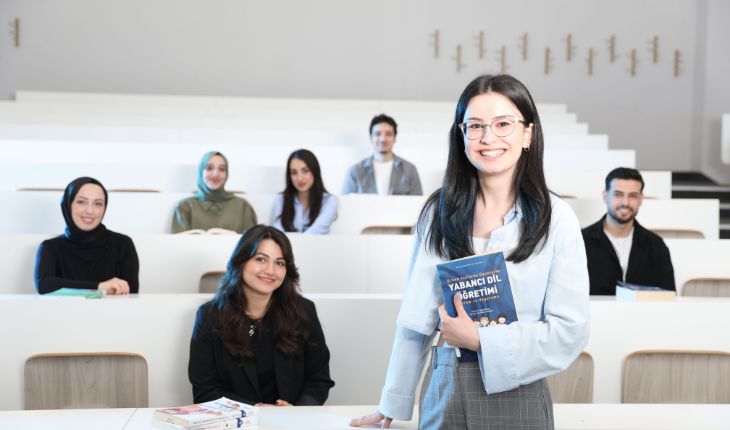
Bahrain is emerging as the regional and international hub for higher education, offering promise to those seeking to pursue careers ‘at home’.
As students ride the emotional rollercoaster of ‘which university to attend’ in the coming weeks, they and their parents can find assurance knowing that the kingdom has entered many academic partnerships in the last few years. Additionally, there has been a series of government policies aimed at making the island one of the Gulf’s most attractive destinations for international pupils.
This week, Bahrain became the first country in the region to introduce the prestigious International Baccalaureate programme in government schools, nodding to Bahrain’s efforts to offer quality education aligned with global standards.
The National Strategy for Higher Education and Scientific Research (2026-2036) was announced in April, with the aim to strengthen Bahrain’s presence in international university rankings and expand cross-border academic co-operation.
Several Bahraini universities are now ranked in global classifications such as the Times Higher Education and the QS World University Rankings, Education Minister Dr Mohammed Mubarak Juma revealed.
In a recent report published in GulfWeekly’s sister paper, the GDN, Dr Juma highlighted that more than 82 international programme accreditations have been secured, including ABET for engineering and AACSB for business studies. Additionally, Bahrain has signed mutual recognition agreements for higher education qualifications, most recently with Cyprus, while Bahraini universities are listed among recognised institutions in several GCC and Arab countries, including Saudi Arabia and Jordan.
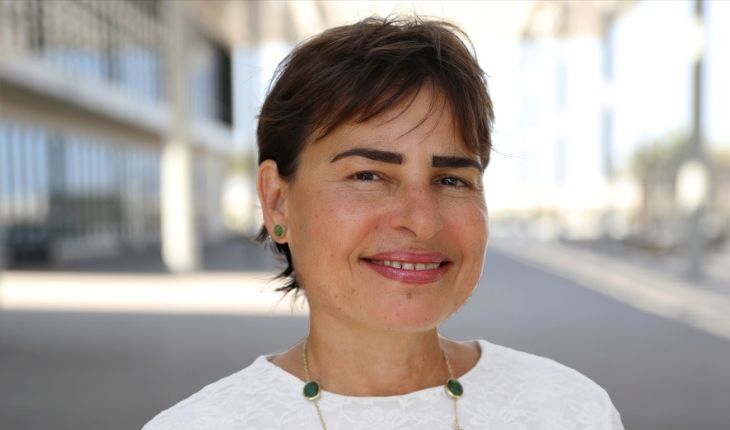
“I have witnessed remarkable progress in higher education during the more than 20 years I have worked in Bahrain,” American University of Bahrain professor Maria del Mar de Fez Laso told GulfWeekly.
“The sector has evolved significantly, with strong quality assurance mechanisms, clear educational frameworks and a growing emphasis on student success. I have also had the privilege of working alongside many dedicated educators who are deeply committed to their students and their institutions,” added the Spanish expatriate and academician specialising in physics, astronomy and mathematics.
Complementing the efforts of individuals, institutions and the Bahrain government to position itself as a regional and global hub for higher education, the 58-year-old has designed a new learning method that transforms students from passive recipients of information into active participants.
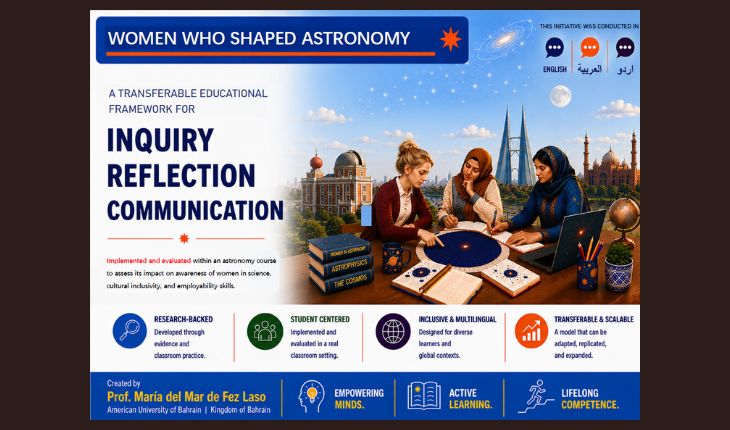
“The IRC Framework (Inquiry, Reflection and Communication) is a structured yet highly adaptable pedagogical approach. Students begin by investigating a topic through inquiry, learning how to search for information, evaluate sources and formulate meaningful questions.
“They then engage in reflection, connecting new knowledge with broader scientific, social and personal perspectives. Finally, they communicate their findings through written and visual formats, strengthening their ability to express ideas clearly and effectively,” explained the Amwaj resident.
The expert highlighted that since the first implementation of the method, more than 80 per cent of participants have described the experience as valuable.
The first implementation of the IRC Framework has been documented in a booklet entitled Women Who Shaped Astronomy. While the publication showcases an astronomy-based application – hence the title – the framework itself is not limited to the field and was designed from the outset to be transferable across disciplines.
One of its distinguishing features is its integration of AI-assisted tools within an educationally meaningful process.
“Rather than treating artificial intelligence as a shortcut, students learn to use AI critically and responsibly to support research, translation, content refinement, visual design and communication. This mirrors the reality of modern professional environments, where the ability to work effectively with AI is becoming an increasingly valuable skill,” she added.
The framework therefore develops not only subject knowledge but also a wide range of transferable competencies, including critical thinking, communication, digital literacy, creativity, cultural awareness, ethical use of technology and lifelong learning skills.
“Modern curricula are necessarily structured around disciplinary knowledge and measurable learning outcomes, which are essential. At the same time, many of the challenges that graduates face in their professional and personal lives do not fit neatly within a single discipline.
“For this reason, I believe there is great value in creating learning experiences that encourage students to connect ideas across fields, explore broader societal contexts and develop transferable skills alongside subject knowledge,” Maria added.
Over the year, the professor plans to expand the IRF Framework’s application to additional disciplines, including mathematics and other STEM fields, in order to evaluate its impact on student engagement, interdisciplinary thinking, communication skills and the responsible use of AI-assisted tools. Additionally, she hopes to share the framework with the wider educational community through conference presentations, workshops and scholarly publications.
“I believe that innovation in teaching becomes most valuable when it is openly discussed, critically examined and adapted by others. At this stage, my focus is on building a robust evidence base and fostering collaborations with educators who are interested in exploring new approaches to active and interdisciplinary learning. I would certainly welcome opportunities to work with educational institutions that share these interests,” she added.
The booklet is available on zenodo.org.


_20260813104204.jpg)