
_page-0001_20260903101241.jpg)




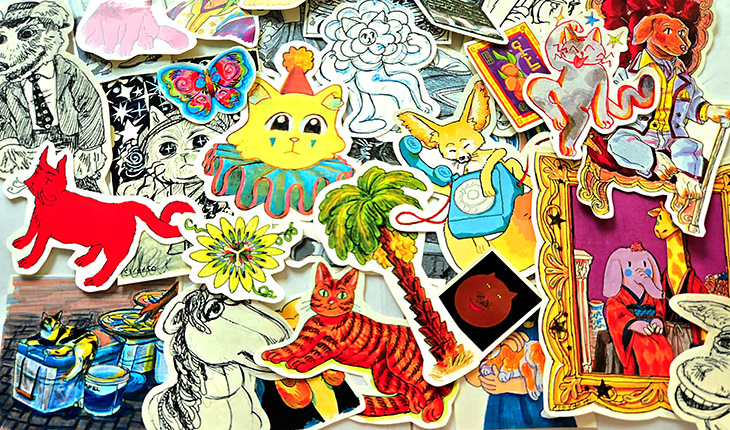
Artists across Bahrain are restoring a prized childhood currency through unique designs and local activations, sending millennials and Gen Zs down the road of nostalgia.
Those who grew up on the island during the 90s and early 2000s will fondly recall the ‘golden years’ characterised by peelable art, collectible cards and tazos.
“My older brother and I used to collect Suntop stickers when we were kids,” creative talent Shaikha Maryam bint Khaled Al Khalifa told GulfWeekly.
“The cold store would hand out the sticker books and filling those pages became our little obsession. There was something deeply satisfying about the ritual of it all – peeling the stickers free, trading them with friends and slowly watching the pages come together,” added the 32-year-old from Riffa.
She recounted that it was not just the collection that mattered, but also the sense of anticipation and joy that came with it.
The artist went on to train at Parsons School of Design, New York, and eventually opened her own studio. Most of her work is inspired by Bahrain, the Gulf and broader Arab culture.
“Many of my stickers incorporate old Bahraini phrases, which often spark interactions with patrons. Sometimes, the words arrive wrapped in laughter and nostalgia and, at other times, they open doors to conversations about their meanings and origins. In those moments, the stickers become more than objects – they become vessels of memory and cultural inheritance,” added the founder of Camel in the City design studio.
In addition to stickers, the three-time New York Design Week participant pursues diverse techniques, from 3D to screen-printing. A few years ago, while screen-printing a new batch of designs, she realised they would also translate really well as stickers. Since then, she has been creating sticker versions of her t-shirt designs in addition to the original peelables.
Once used as trading symbols, stickers entered the mainstream in the 70s and, by the 90s, were a major pop culture sensation. Sticker books became a global trend with students using the artistic labels to decorate journals, folders, lunch boxes and lockers, all as a way of personal expression.
Even brands started producing them, from the ubiquitous Pokémon collectibles to Disney and several music bands like Linkin Park and Nirvana.
In 2015, Suntop launched a social media campaign, inviting fans and collectors to upload a photo of their booklets for a repost on the brand’s Facebook page.
Over the years, new styles of the art have also emerged, including holographic, fragrant, puffed and glossy.
For GulfWeekly and GDN news reporter Zainab Almahdi, the sticker mania took over during school. “Everyone had sticker folders and would collect varied designs,” said the illustrator and comic artist from Muharraq, who took a shine to the hobby, eventually creating her own peelables.
The 28-year-old has facilitated sticker-making workshops at the Art Station in Muharraq with a major portion of her work inspired by felines and anthropomorphising nature. She has also painted murals and released comic books, with some drawings published globally.
Stickers can also be used to send strong social messages and many artists use the style to raise awareness about important causes. Among them is Aliyah Sultan, who designed a special collection for the Gaza in the Heart exhibition at the Safeya Kanoo Hub in 2023.
“Knowing that every single sale went directly to support Palestinians in Gaza changed how I viewed my purpose as an artist,” said the Muharraq Secondary Girls School pupil, who won second place in Bahrain Summer Nakhool Star competition in 2021.
The milestone spurred her on to pursue her love for illustration and storytelling.
Recently, she compiled a charity sticker collection entitled Bun Reads for local volunteer group Far7a that stages the Annual Charity Used Books Fair in the kingdom.
“I designed a super cute, ‘nerd-chic’ character who wears glasses and has her hair up in a bun, completely obsessed with reading and collecting books,” said the 15-year-old.
Aliyah’s love for stickers goes back to when she would patiently wait for Majid magazine to come out each month.
“It always came with a sheet of colourful stickers and I used to joyfully plaster them all over my notebooks and sketchbooks and the wall right above my study table.
“What makes sticker-making so unique when compared to storybook illustration or animation is that you don’t have a background to help explain the scene. The character or object must have a ‘stand-alone’ impact. It must tell the entire story, show an emotion and express a mood all by itself at just a single glance. To achieve this, I make my colours much brighter and keep the illustrations clean with fewer details,” she added.