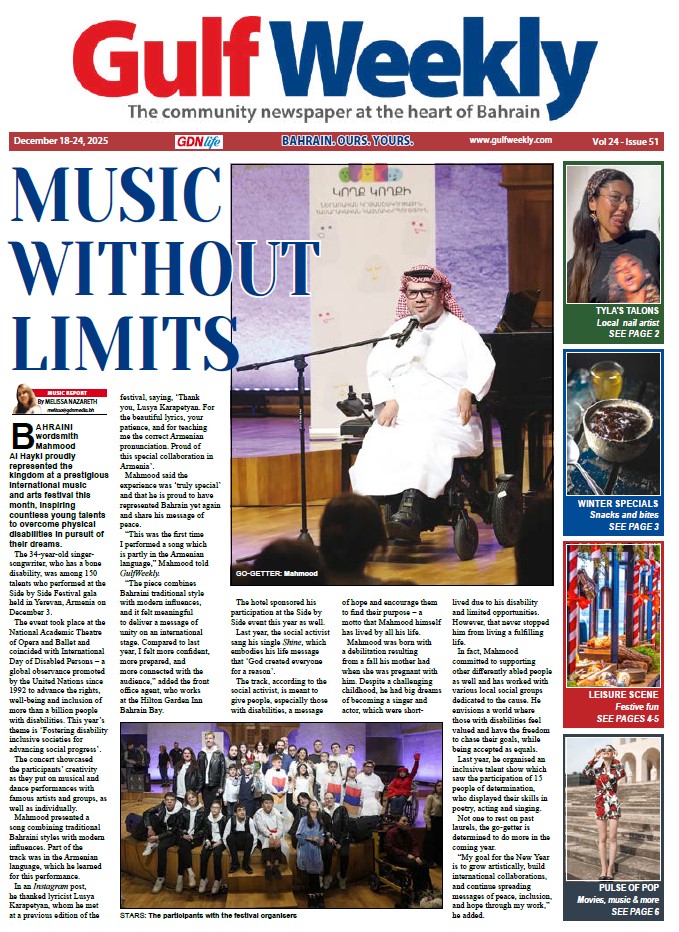
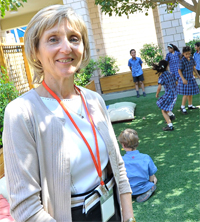
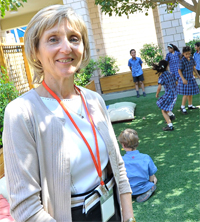
TACKLING breast cancer requires a combination of excellent care, a positive attitude, determination and support from family and friends, says survivor Wendy Bataineh, who has recently been given a clean bill of health by doctors.
The 55-year-old head teacher of St Christopher’s Junior School in Saar has battled two malignant tumours that were detected almost a year ago during her annual mammogram check-up at a Bahrain hospital.
She has had to undergo surgery followed by debilitating chemotherapy and radiology sessions before regaining her health.
The disease, according to the World Health Organisation, is the leading cancer killer among women aged 20-59 in high-income countries.
Looking bright and cheerful, Ms Bataineh recalled her experiences, saying: 'I am not a particularly brave or different sort of person. If I could deal with it the way I did by staying positive and getting energy from all the support I got from my friends and family, so can anyone else.
'The frightening thing about cancer is that you don’t feel in control. It is attacking your body and you are worried because you didn’t know it was there and yet there it was secretly devouring your body.
'It does take over your life for a short amount of time but you can read about it and make changes to your lifestyle and diet. It makes you feel that you are also doing something to help – the doctors are doing things to you but you are also contributing. This teamwork makes you feel a lot more in control.
'There were times, in the middle of the night, I would wake up and feel scared and think the worst. But, most of the time I managed to stay positive.
'I know often people say, ‘why is it happening to me?’. But I didn’t feel like that at all. I thought to myself ‘why shouldn’t it happen to me?’. Because, when you read about it you realise how many people are touched in some way with some form of cancer.
'So rather than ‘why me’ there’s no reason ‘why not you?’ That’s how I felt but also I tried all the time to think that I am going to beat this and I am going to throw everything at it.
'My day-to-day life now is very similar to what it was before ... except, I guess, I really enjoy the simplest of tasks like taking my dog for a walk. You have the feeling that you need to appreciate the smallest of things.'
After detecting a non-malignant lump several years ago, Ms Bataineh had been going for annual pap-smear and mammogram checks.
Last year, a radiologist gave her the bad news during a regular scan, adding that the tumour did not look good.
Following a meeting with a surgeon in Bahrain, Ms Bataineh consulted physicians in London who revealed she was suffering from Stage 2 malignant cancer that required immediate surgery and further treatment. Almost all of last year was spent travelling to and fro, between London and Bahrain, getting treated and returning to work.
Ms Bataineh said: 'This time last year I was diagnosed with breast cancer and even when they saw the mammogram, the radiologist told me, quite abruptly, that she had no doubt that it was malignant. So, quite early on, I was prepared for the fact that it was not just a simple tumour.'
'These particular lumps were quite deep inside the breast and therefore you could not even feel them. Even the surgeon could not feel them. I would like to emphasise that it is very important that women get that health check.
'It was quite shocking. The lady who checked me asked me to take an appointment with the surgeon, which I could not for two or three days. In that period I held on to that knowledge and did not talk to anyone about it because I still couldn’t quite believe it and I needed to give myself a bit of time to get used to it.
'The surgeon more or less agreed with the radiologist. It was only then that I decided to tell my daughters. It was probably worse than receiving the news myself. I found this whole experience to be very traumatic.'
Ms Bataineh lives in A’Ali and has two daughters, Marion, 29, a mother of a seven-month-old baby girl, Al Anoud, who lives in Jordan with her husband, and Alyaa, 24, a nursery teacher at St Christopher’s School.
'It stands out as the worst moment because you always want to protect your children,' she explained. 'They are young women now but you want to protect them and you don’t want to upset them and there’s nothing I could do about it. So for me that was the absolute worst.
'But I have been very lucky. I have close family and friends who were great. They were supportive and they accepted the best thing I could do was to deal with the cancer and at the same time carry on working and come to school. For me that kind of normality was particularly important.
'I was also lucky to find a team of females – surgeon, oncologist and radiologist in London – whom I felt very comfortable with. As a woman I felt they empathised with me without my needing to say anything. It was like they understood totally what losing a breast might mean to you.'
She said that the 10 days that followed every chemotherapy session was very tiring but she would continue her work despite days when she felt unwell because of the drugs in her system. She received four sessions of chemotherapy that was administered intravenously as she sat on a reclining chair.
Ms Bataineh even tried a very painful session of scalp cooling through a chemotherapy session to help reduce hair loss. It is administered by putting a helmet-type cap attached to a freezer and cools your head to –6°C. She has, however, lost almost all her hair, although it is now growing back. She often wears a wig so most people do not even notice.
She said: 'Some people say that losing hair is the worst part of the whole experience but, I don’t think so. To be honest you can take that positively because it shows that the chemotherapy is working as it attacks all the cells in your body, especially those that grow the fastest, including hair and nails.
'It is easier when short hair comes out. It is more difficult with long hair when it comes out in lumps and blocks the sink!
'I was advised to go and get a wig even before I had the first chemotherapy session. The person in the shop could then see your hair the way it was and help you match it so it looks more natural later on. Sometimes I put a scarf on and I also have a fringe that I can put under the scarf.
'I wanted the wig especially because of the children at school. As much as possible I wanted things to appear normal.
'Everyone says my hair will grow back although you are not sure how it will grow back. Sometimes it grows back in a completely different colour, sometimes it gets curly when it used to be straight and at our age you think it is going to come back grey. At the moment it is a darker colour than it was.
'With the chemo they give steroids that are anti-sickness pills and they also have the affect of keeping you awake. You try and sleep but you can’t and you are hyper. It then gradually depresses your immune system and makes you feel very weak ... you feel a little ‘spaced out’ because there are quite a lot of drugs.
'It was only during the first one that I was sick. By the next session the drugs were combating the nausea. Sometimes my energy levels were very low. After the fourth, I was very weak and even going up the stairs at home was hard. I would reach the top and would be terribly exhausted.
'Radiotherapy is not so difficult. You have to go every single day and it is for a few minutes. They say it makes you tired but it is nothing like the tiredness you feel after a chemotherapy session.'
Ms Bataineh believes researching about breast cancer through books and on the internet helped her gain a lot of understanding of the disease. She read about nutrition, benefits of certain foods over others and adjusted her diet accordingly. 'Through the cancer I cut down almost completely on dairy products,' she said. 'I started taking flax seed ... my breakfast in the morning is a lot of fresh fruit with flax seed. I have cut out red meat completely and now I try to buy organic chicken and milk.
'In some ways I think having cancer makes you take stock of things. It makes you think what is really important and you feel that life is precious.
'You feel that people are precious ... I was overwhelmed by the messages of support I received. Some of the teachers would just send me a text message, but it felt so important to know that people were thinking about you and rooting for you.
'All of that does make you feel wanted and loved. We are always so busy and in a way being ill like that, and having to seek treatment, kind of forces you to make space in your life. I did get in touch with a lot of friends whom I had lost contact with because I am no longer living in the UK.'
Throughout this month people across the globe are promoting breast cancer awareness, none more so than the charity champions behind Think Pink Bahrain. Ms Bataineh hopes to play a part too. She said: 'My advice to all women is to please make sure that you have your timely health check-ups. The second thing I would say is talk to people about your fears. I would be very happy to talk to anyone in the same situation if they felt it might help.
'It is a great relief to meet someone who has been through it all and is now going about their normal, everyday life and not having to think too much about the fact that they had cancer.
'So don’t worry alone, talk to people. It is amazing how friends, not necessarily those who have been through it, can show you empathy, understanding and support.'