Visually-impaired Olympian Henry Wanyoike may have lost his sight but he hasn’t lost his vision as he continues to take strides in raising awareness about avoidable blindness with every step that he takes.
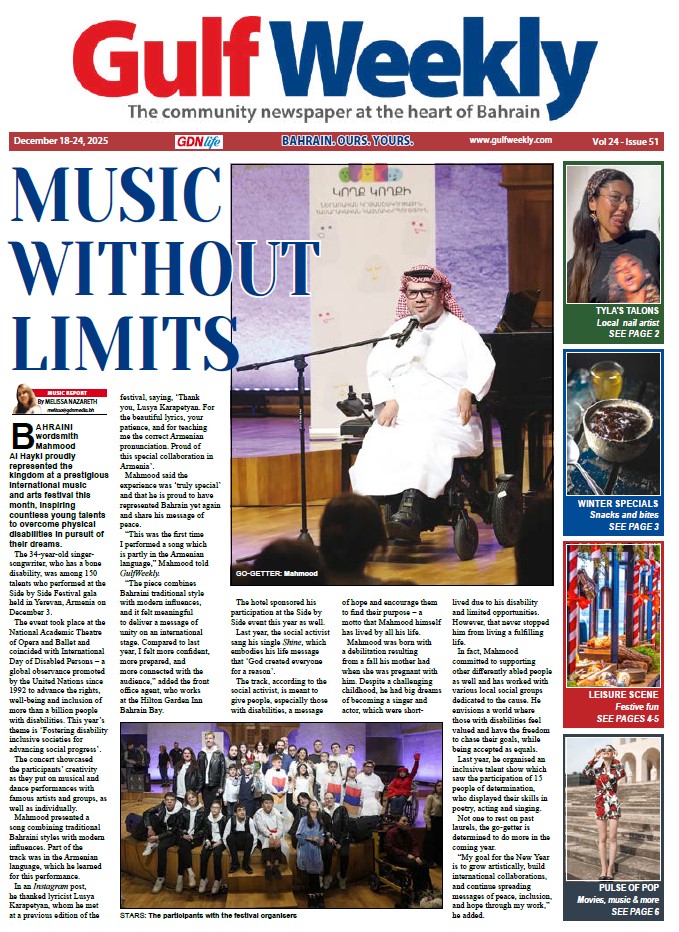
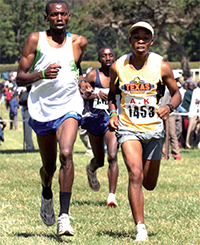
Kenyan athlete Wanyoike and his long-time running partner, Joseph Kibunja, 36, recently touched down in the kingdom to race in the annual Bahrain Marathon Relay.
The duo were acting as goodwill ambassadors for Standard Chartered Bank’s global community programme ‘Seeing is Believing’, which aims to help 20 million people around 20 cities to avoid any preventable loss of sight.
Wanyoike, 39, said: “It’s my first time in Bahrain. I came to the island to raise awareness about ‘Seeing is Believing’ and reach out to as many people as possible to let them know that with hard work and determination everyone can achieve their goal.”
The runner has been supporting the global bank’s initiative since it was launched in 2003.
Bound by a tether on the wrist, Wanyoike and Kibunja took on a number of international athletes attracted to the popular race and they have also participated in other Standard Chartered supported marathons in Mumbai, Hong Kong, Singapore and Dubai.
The ambassadors were brought to the island as part of the campaign’s 10th anniversary. Leading up to the relay, Wanyoike and Kibunja held talks and motivational presentations at local schools including the Saudi Bahraini Institute for the Blind, the Bahrain Association of Family and Friends of the Disabled, the Bahrain Special Olympics Committee, business community members and the Friendship Society for the Blind.
Noora Al Nusuf, the Bahrain bank’s head of corporate affairs, said: “Having Henry and Joseph here in Bahrain as part of the bank’s initiative has been great. Their representation of the initiative and determination to raise awareness has been remarkable.
“There are 39 million people who are blind across the world and a further 246 million people with low vision. The vast majority of these people could be helped if given affordable access to eye-care.
“We also had the honour and pleasure of being received by His Highness Shaikh Nasser bin Hamad Al Khalifa, president of the Bahrain Olympics Committee and chairman of the Council of Youth and Sports, who gave us his full support and encouragement to continue what we’re doing in raising awareness and giving opportunities in the sporting world to those who are physically impaired.”
During the visits, Wanyoike shared his story with the visually-impaired and blind youngsters of how he first discovered his own blindness and overcame the fear by sheer determination.
He said: “Meeting the children was a treat for us. It was great meeting such very bright kids. They asked some smart questions and were very positive about the future.
“We also met the winners of the Standard Chartered inter-school competition for the marathon relay, Naseem School. They were great kids with so much energy and enthusiasm.
“I made sure to tell them not to take things for granted. Work hard and be determined. With the right attitude anything can be achieved.”
Wanyoike was born in the Kanjeru slums in Kikuyu, a rural area in Kenya, and his running prowess was quickly acknowledged. He excelled at the 5,000 and 10,000-metre distances.
He was being groomed to join an elite corps of athletes in a country known for producing more world-class middle-distance runners over the last 20 years than any other, when in 1995, Wanyoike woke up one morning blind after suffering a stroke, losing 95 per cent of his vision.
He said: “I lost my sight when I was 21. I went to sleep and woke up and was never able to see again. The left side of my body was also paralysed.
“I was obviously very scared and felt frustrated at the beginning. I had always wanted to be a champion and a winner representing Kenya. I ran before I lost my sight and worried that the dream might have been over. Having said that, I put my mind on making it work out, no matter what.”
His mother Grace brought him to the Kikuyu Eye Clinic, which is recognised as one of the best centres for the visually-impaired in East Africa. Petra Verweyen, the chief of the Low Vision Project of the clinic, helped him find his way back into life and arranged for him to learn to knit pullovers. But the pull of running was much stronger.
With gratitude for the help he received at the project he promised himself he would help other blind people and teach them to become self-sufficient, as he had done.
He took part in an Olympic day run that enabled him to participate in the national trials for the Sydney 2000 Paralympics in Australia where he easily bagged a gold medal in 5,000 metres.
Since then, he has been deemed as one of the world’s fastest runners, winning both local and international track competitions and marathons for both the disabled and able-bodied.
He makes sure that he is diligent with his training, practicing at least three-times-a-day running with his childhood friend Kibunja at the Alliance Boys High School grounds or through tea and coffee plantations. Most recently, he won the bronze medal in the 5,000 metres at the Beijing Paralympics.
He added: “I’m proud to say that I’m the 5,000 metres world record holder which was achieved in 15 minutes and 16 seconds. I also won the 5,000 and 10,000 metre races in the 2004 Athens Paralympics with a time of 15 minutes and 11 seconds for the first and 31 minutes and 37 seconds for the last.
“Over the last five years, I’ve won gold and silver medals in marathons, half marathons, 10km races, 10,000 and 5,000 metres as well as 1,500 metres.”
With Kibunja as Wanyoike’s eyes, the athlete has become unstoppable. His friend quit his carpentry business to support him on the track.
The duo’s words of wisdom have encouraged Abdulrahman Mubarak Al Saeedi, 14, from Riffa, who attends the Saudi Bahraini Institute for the Blind in Isa Town, to never give up.
The youngster, who suffers from low vision, said: “It was a great opportunity to meet such a hero. Thanks to his talk I am more motivated than ever to continue playing sport. His words had such an impact on me and touched my heart.”
Abdulwahid Al Khayyat, the manager of the institute, was also thrilled with the positivity the duo created when they visited. He said: “It gives our students hope that they too can reach the highest level.
“When they meet a champion it gives them more confidence and ambition that they can achieve greatness, not just in sport, but anything in life. They can all play a positive role in society. Students who have gone off to university, graduated and obtained good jobs also give them inspiration.”