





ALEADING health lecturer believes sports clubs across the kingdom should have a vital piece of equipment to get the heart beating properly at hand in case of emergency, writes Anasuya Kesavan.
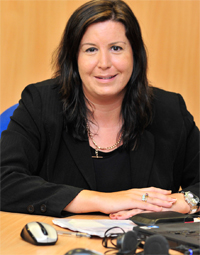
Orla Merrigan, a lecturer in nursing at the Royal College of Surgeons in Ireland (RCSI) at Busaiteen has uncovered shocking statistics which reveal many places which attract large crowds are also lacking the automated external defibrillators (AED).
“There is a condition called Commotio Cordis when sudden unexpected death occurs in young people playing sports,” she said.
“Even if healthy people bang together during a game chest trauma can occur causing the player to collapse and suffer sudden cardiac arrest. We have seen this in football, basketball, cricket, and karate and many experts are now saying that anywhere sports are played should have an AED available.
“I surveyed some football clubs here, basketball arenas and swimming pool areas. Not one of them had an AED. I would say it is more important than the fire alarm system in a building. I am biased, but they should have them everywhere.“
Orla’s research, funded by RCSI for projects with a community link, revealed that among 84 public spaces only one bank, four universities, one shopping mall, three clubs, three hotels, one factory, three schools, one embassy, one gym and one compound – in which a resident died from a heart attack three years ago – had an AED. Both water parks in Bahrain were also ‘very good’ on health and safety grounds, she said.
With a background in coronary care, Orla, from Ireland, who has been working in Bahrain for 20 months, said: “I read in a newspaper about a child who had collapsed and died in a mall and it motivated me to carry out this research.
“I found that we have very few public defibrillators here. Although there are no statistics for Bahrain, global statistics suggest that annually approximately half a million people die of cardiac arrest.
“Most cardiac arrests are witnessed and 20 per cent happen at home. So, if you have a teenager at home who knows how to do CPR, at least if a relative collapses there will be help at hand before an ambulance arrives.
“It is just about raising awareness. A study was carried out in the US that showed that once trained, even 14-year-olds could perform CPR as well as any professional. So, my advice to schools is not only to get AEDS and train teachers, particularly the PE teachers, but also some senior school students too.
“There is lack of awareness to be fair because many people do not seem to be aware that a simple machine, which people could easily be trained to use, is available. Significantly, the cost of equipment does not appear to be an issue.”
The equipment is readily available and priced at around BD800. She added: “They have seen the sort of large equipment which is available in hospitals but were not aware of the small portable versions available.”
The modern AED is extremely light and even guides the user with a voice aid on where to place pads on the body, analyses a victim’s heart rhythm, indicates when CPR should be performed and only gives shock treatment when necessary.
Orla is now planning to complete a PhD on AEDs in the Gulf region and hopes to reach health and education authorities and the Royal Court in Bahrain to try and bring in legislation that makes AEDs compulsory in public areas.
She is also investigating post mortem data and taking into account cultural barriers in the Middle East with the hope to presenting her finding at a conference in the US this month.
She said: “Scotland used to be the heart attack capital of the world but the Middle East has taken over with cardio vascular disease and obesity and there are so many young people with undiagnosed heart conditions.
“Anywhere where there are lots of people gathering together – including the local mosque – needs a defibrillator. My research is not a ‘name and shame’ exercise – it is purely to raise awareness. It is about being proactive rather than reactive.”
Orla is willing to give talks on the subject to interested parties. Email omerrigan@rcsi-mub.com


