

_page-0001_20260903101241.jpg)




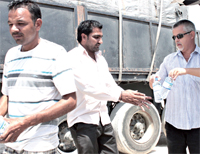
Many young boys dream of driving an 18-wheeler lorry and hitting the highway, but for the lorry drivers stranded by the Saudi Arabian boarder in Bahrain, theirs is a road to misery.
Thousands of commuters and businessmen make the journey across the Causeway every day, most making it within an hour. However, for the lorry drivers trying to provide an essential service between the two kingdoms’ by transporting goods and raw materials, the trip is sometimes taking days.
Once again, during the past fortnight, drivers have found themselves enduring days of agonising and relentless waiting while customs officials turn them away to join an ever-growing queue while paperwork is being processed and security checks carried out.
Many drivers are left in dire straits and are forced to survive in appalling conditions in a make-shift camp on a patch of open, dusty ground off the Isa bin Salman Highway near Janabiya.
With limited supplies of food and water, and with a very real fear of running out of fuel, the drivers, many of whom are from India, Bangladesh and Nepal, have been forced to wait with no indication of when they can expect to complete their journeys.
Lorry driver Antony Wilson, 47, from Juffair, had unsuccessfully attempted to cross the border on several occasions and described the situation as ‘worse than prison’.
“I’ve been stuck here for two days with no facilities at all,” he said as sweat slowly dripped down his face, making a sizzling sound as it hit the dusty road beneath his feet.
“It’s hot, my shirt is drenched in sweat and I’m not going to waste the little water I have left trying to wash.
“At least in prison it’s air-conditioned and they give you water, I feel like I’m living as an animal while stuck here. Something needs to be done because people can’t continue living like this.”
His morning routine consists of finding someone willing to share some food and water with and then wandering around aimlessly, never more than a few feet from his lorry in case one of the police officers parked up close-by indicates that it’s his turn to leave.
“It’s very boring and there’s practically nothing to do except try to stay out of the heat and wait to be asked to move, and if that doesn’t happen, I’ll try to sleep,” he said.
Antony’s struggle is amplified by the fact that his family are back in his native India, unaware of his plight. He has not told them for fear they will worry about him on top of their own challenges.
His wife Mary Anita works as a staff nurse and his son, Blesson, 14, is currently working his way through 9th Standard at school.
Many people carry pictures of loved ones with them but Antony’s favourite picture of his family sits proudly on his bedside cabinet in his lodgings.
“They have enough to worry about without me adding to it,” he said. “I wish I had their picture with me because it can be lonely here at night, even with all these other lorry drivers around.”
As Antony whiles away his time at the make-shift camp, an idle flurry of activity buzzes around during the day like the flies that circle around the nearby waste ground the drivers are forced to use as a toilet.
While some of the drivers have built relationships with those who share their unenviable predicament, others have taken to the solitude of their cabs to pass the time.
Although lorries have ample storage space for goods and materials, there is often only a small area at the back of the cab to provide the drivers with a place to rest. The claustrophobic conditions proved too much for some, who opted to find a shady spot outside to wait for an infrequent refreshing breeze.
As a result of the delay getting across the Causeway, the drivers have developed a sense of ‘war time’ camaraderie, sharing what dwindling supplies they have and helping each other whenever possible.
“We only really have each other to count on,” said Antony as he grabbed some shade by perching along a nearby truck. “I love living in Bahrain but I don’t understand why this kind of thing happens and no one seems to be doing anything about it.”
Water in particular is an invaluable commodity under the blistering late summer sun, which still sees temperatures reaching upwards of 40 degrees.
Fuel conservation remains a constant concern. Turning on individual air-conditioning is considered a luxury so several drivers share the same cab for a few hours, before switching to another lorry, to find reprieve from the heat.
Smiles erupted on the drivers’ faces when the familiar chimes of a bell were heard in the distance. A solitary ice cream truck arrived on its daily visit to offer refreshing treats.
One man’s agony is another man’s opportunity to make a profit in the desert. But the van’s music does manage to inject a much-needed morale boost to the camp as the drivers gather like a line of happy and eager schoolchildren.
Ice cream vender Satwinder Das, 23, made his rounds along the trail of 30-40 trucks offering cool desserts at around 500fils-a-time and a friendly ear for free.
“I feel so sorry for these people,” he said. “There’s no cold store nearby and they can’t leave their vehicles, there are so many problems.
“I have friends who are also lorry drivers so I understand what they’re going through, I just hope the situation gets resolved soon and these guys can go home.”
Members of the community have also been touched by the conditions the drivers have to endure as they pass by on their way home from work to their comfortable villas around Saar.
Big-hearted Robin Burnett, was not content to rest on his laurels while the men suffered. The 56-year-old from Barbar read about the congestion in the Gulf Daily News, our sister newspaper, and was determined to do his ‘Christian duty’ and help out by driving to the camp with a crate of bottled water.
He said: “It’s nothing special; it’s what anyone would have done. For me, 100fils for a bottle of water is nothing but for these guys it can make all the difference. I just wish I could do more.”
Robin, who ironically works across the Causeway in Saudi with the traffic police, has experienced prolonged delays like many others who make the daily or weekly commuter journey.
“I’ve been stuck waiting there for three hours before, but some of these people have been waiting for three days! It’s appalling,” he said.
The kingdom has tried to establish itself as a hub for growth in the region as an ideal base with excellent links to its mighty neighbour. However, the backlogs in deliveries to and from Saudi and across the Gulf States are proving costly in many ways. Businesses are facing financial hardship and the island’s reputation suffers as a result.
The cause of the delays is well documented. The finger has been pointed at a shortage of customs officials and competent clearing agents plus a lack of space on the Saudi side. The often-quoted solution appears to be a case of creating more truck lanes, reclaiming additional land and increasing safe areas for trucks to line-up.
The will to permanently solve it appears to be missing and the misery for the truckers and their companies will continue until it is found. This time the truckers wait was resolved over the weekend after the furore in the local press. They all fear it is just a temporary reprieve and that as soon as the dust settles they will be forced to park up in Janabiya for days once again.


