

_page-0001_20260903101241.jpg)




The backlash has started, although the damage has already been done.
UEFA fined Serbia around BD40,000 and instructed them to play their next Under-21 international behind closed doors following widespread abuse and violence that marred England’s European U-21 Championship play-off in October.
Bizarrely, Serbia’s punishment was the toughest UEFA was allowed to sanction under its rulebook.
While players from both sides received bans, the maximum being four games, this was attributed to fighting (improper conduct) rather than racial motives.
Michel Platini, UEFA’s president, has agreed to review the decision next week when he receives the full reasons behind the judgment.
Could this be good for the game? Let’s face it, if UEFA had issued Serbia with a marginally heavier fine and banned them from international competition it would have sent the right message, although how many people would it have impacted and how quickly?
The global outrage and venting of fury at the judgement’s leniency has certainly proven the general desire to see UEFA introduce more radical measures. This can become positive if Platini acts strongly. He knows he has the backing of millions, including national associations.
There is a significant disparity between the sanctions imposed by the English Football Association and the European governing body.
In recent times it has handed out an eight-match ban to Luis Suarez for racially abusing Patrice Evra and John Terry was suspended for four games and fined £220,000.
Now draw comparison with Serbia’s fine, which itself contrasts famously with the £80,000 fine they handed to Nicklas Bendtner for lowering his shorts as he celebrated scoring to reveal the name of a sponsor, suggesting that UEFA is more interested in protecting its commercial partners than its members and ignoring its social responsibility and the wider message.
It is apparently quick to acknowledge the positive impact football can have in healing rifts and generating income when looking outwards, yet disregards these same functions of the game while meting out punishments to offenders.
Players have direct responsibility and control over their actions and while institutions and clubs retain the same obligations, they do not have the same degree of direct influence. Punishments need to reflect this and persistent offenders need to see an escalation.
Somewhat ironically, Manchester City’s Serbian defender, Aleksandar Kolarov, is the latest player to find himself subject to a racially-motivated investigation after he became engaged in a lengthy confrontation while warming up with two Newcastle supporters waving an Albanian flag. Serbia has a long history of tension with Albania over the disputed territory of Kosovo.
The Newcastle fans are believed to have complained to stewards who then alerted police.
It would be unfair to only highlight UEFA as being an organisation in need of a change in regulations.
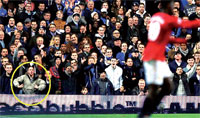
The Crown Prosecution Service (CPS) in London announced that there was ‘insufficient evidence’ to charge a Chelsea fan pictured making a monkey gesture at Manchester United’s Danny Welbeck.
Despite the image bringing global disdain and the Metropolitan Police identifying Gavin Kirkham from CCTV footage, the CPS confirmed: ‘There is therefore insufficient evidence for a realistic prospect of conviction and we are therefore not bringing a charge against this individual’.
This is in stark contrast to the fortunes of Liverpool fan, Phillip Gannon, who was found guilty of racially abusing Manchester United’s Patrice Evra for making a similar gesture. He was officially banned for four years from Liverpool and England matches, fined £180 and found guilty of two counts of using abusive or insulting words within the hearing or sight of a person likely to be caused alarm or distress, despite his attempts to claim his comments and gestures were a reference to ‘cavemen’.
The difference between the two cases appears to be in the content of the witness statements of those surrounding the offenders. While in Liverpool other supporters endorsed the apparent motive behind the images, those in Chelsea did not.
Refreshingly, Chelsea has stood by its decision to ban the ‘fan’ for life, matching the ban imposed independently by Liverpool.
The enhancements in security arrangements have allowed for greater surveillance of the behaviour of fans.
There is a growing belief that football is not treating the matter seriously, despite the establishment of the Kick It Out and Show Racism the Red Card campaigns.
Earlier this year, Blackburn striker Jason Roberts refused to wear the Kick It Out T-shirt and this week Lord Ouseley resigned as its chairman in protest at the ‘backward steps’ football is making towards tackling racism.
While UEFA’s initial sanction is deplorable, they have a real opportunity to now send a strong message while re-writing the rulebook.
The world is watching.


