

_page-0001_20260903101241.jpg)




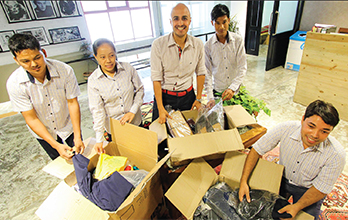
Children who are returning to class in tarpaulin tents and makeshift cottages in devastated Nepal will soon be wearing new school uniforms to replace the clothing they lost in the earthquakes that have rocked the country.
A shipment is winging its way to the country through the Bahrain Red Crescent Society thanks to a donation of 500 boxes of supplies from local retailer, House of Uniforms.
Yacoob Akbar Jawad, the company’s general manager, has contributed T-shirts, polo shirts and socks alongside school uniforms, plus warm clothing such as pullovers for when the temperature drops.
Mr Jawad said: “It’s a beautiful thing to know that despite what these children and families are going through, education is still high on their priority list.
“We hope that by donating these uniforms, it will help make the children’s journey to school more enjoyable, unify them as one, as well as make them feel as though things will eventually get back to normal.
“Also, as a lot of these schools are using makeshift classrooms, having similar uniforms and identical clothing will help identify them as students for safety and accountability reasons too. Our items are comfortable and durable cotton-rich clothing so it will last them a long time.
“We have worked closely with many organisations in the past to donate uniforms for good causes. One of my favourite institutions is the Kanoo School. Every year a group of students travel to a disadvantaged country and do charity work and each take a box of clothing from us. They always come back telling me in detail how happy the kids are who have received the items.”
Mr Jawad jumped into action when one of his employees told him the story of her cousin, a female engineer in Nepal. The woman’s entire family, including her husband, seven-month-old baby and uncle were buried under rubble during the first 7.8 magnitude earthquake which struck on April 25.
He said: “She described the scene in such detail that it pulled at my heart strings. She shared how her cousin had rushed to try and cover the baby and their bodies were found holding each other. It was so sad.
“Her parents survived and are currently living outdoors in tents with little or no sanitation. It’s cold and raining.
“We must remember that we are continuously bombarded by the media about atrocities that take place around the world. It de-sensitises us with time. Sometimes it’s not until you are faced with such a personal close encounter that emotions kick in. I’m fortunate to be in a position to help, so I did.”
Thousands of children affected by last month’s earthquake returned to schools just five weeks after the disaster killed more than 8,600 people and destroyed many homes.
Dressed informally, children clutched their parents’ hands before filing past ruins of collapsed buildings to enter their temporary accommodation that will serve as their schools until their old one is re-built.
More than 32,000 classrooms were destroyed across Nepal after a 7.8 magnitude earthquake struck the first time, affecting almost a third of the 28 million population. A second quake of 7.3 magnitude on May 12 also hampered efforts to rebuild.
“I am nervous. It is painful to see my classroom in rubble,” said Shasham Shrestha, a 10th-grader at the Kuleswor Awas Secondary School in Kathmandu.
Shrestha and his friends stood near the collapsed walls of a classroom as teachers assured parents of safety and regular classes. Hari Lamsal, an education ministry official, said opening of schools was important to show that life is getting back to normal.
“We will construct temporary learning centres for schools because reconstruction of old buildings will take time,” he explained.
The government and aid agencies have built 137 temporary learning centres for 14,000 children. Aid workers said over 4,500 education centres will have to be built to accommodate students who have been forced out of their classrooms by the earthquake.
Nearly a million children have been severely affected by the earthquakes, according to the United Nations Children’s Fund (UNICEF).
“Education can’t wait for all recovery and reconstruction,” Tomoo Hozumi, the charity’s representative in the country, told reporters on a visit to a centre – a plastic-roofed structure made from long bamboo strands woven as mats to create walls.
“Opening of schools even in temporary centres has several benefits. It provides psychosocial recovery of children who are in stress, protects them from violence ... the risk of being trafficked and their parents can go to work,” he said.
UNICEF believes $24.1 million was needed to set up the learning centres, train more than 19,000 teachers and volunteers on psychosocial support. School authorities said children will be made to play and interact with teachers before studies start shortly.
Dr Fawzi Amin, the general secretary of the Bahrain Red Crescent Society, and his team, has been working relentlessly to help the Nepalese people.
As soon as tragedy hit they received an appeal from the International Federation of Red Cross and Red Crescent Societies to send aid. They quickly delivered medicines, generators and tents. The boxes of clothing are next on their list of things-to-do.
Dr Amin said: “These people are suffering and donations such as the boxes from House of Uniforms will help the children while the city is in its developmental stage of rebuilding schools and its health system.”
Since the devastation, several Bahraini groups such as the Royal Charity Organisation (RCO) have stepped forward to assist. The first consignment sent by the kingdom was 30 tonnes worth of supplies and the second included 25 tonnes of food, 6,000 litres of bottled water, 1,000 plastic carpets, 300 waterproof tents and 30 power generators.
In total, Bahrain has donated more than 50 tonnes of food aid and provisions such as tents, blankets and plastic carpets, as well as medicines.
The RCO has collected around BD10,000 which will be used towards the reconstruction of housing, hospitals and schools.
The Royal Bahrain Hospital also donated BD5,000. The Rotary Club of Adliya urged members to purchase at least one tent at a cost of BD50 each to provide shelter to displaced families.
And caring individuals and families have been moved to act. St Christopher’s School students, brothers Kyle, 14, and Karan Nair, 16, raised more than BD2,000 when they learned that their Nepalese maids Gita Krishnakumari and Sita Krishnakumari had both lost family members in the tragedy. Their social media site SeismicSupport helped them collect more than two tonnes of food, clothing and 6,000 water bottles, as well as funds.
Volunteers from the RCO, in collaboration with the Art of Living Foundation and the International Association for Human Values, has started work on a Bahrain Camp in Kathmandu which will be a centre with 200 tents for survivors.
* Readers can still donate to the official Bahrain fund, named the RCO Bahrain-Nepal Support Committee at the State Bank of India (account number BH10SBIN02701587120001) and the BBK (account number 100000358458). For details on how to donate to the Bahrain Red Crescent Society, email info@rcsbahrian.org

