

_page-0001_20260903101241.jpg)




It is the world’s most beautiful game that attracts billions of viewers and even more in revenues that also has the worst behavioural concerns amongst players and managers.
Week after week, football from grass roots to the highest professional levels witness players confronting match officials to complain at decisions, sometimes as a complete team, while also using offensive language and gestures.
As you look around other sports it is rare to find such antipathy towards officials. Even in rugby, players respect the decisions made. The genteel game of golf will occasionally witness players taking out their frustration on their equipment although that is generally a demonstration of dissatisfaction with their own performance.
With that in mind, at the start of the season, the Premier League, English Football League and Football Association agreed to stamp out poor conduct that had reached ‘intolerable levels’.
To date the stronger measures afforded to referees appears to have worked with players cautious about questioning the officials while even the technical areas are being more rigorously enforced.
In cricket it is difficult to think of any incident that would warrant a mention, particularly not towards an umpire and especially now that the review system is widely available.
The only incident I can recall was the incident involving Mike Gatting and Shakoor Rana at Faisalabad in 1987– the Test that led to the introduction of neutral umpires!
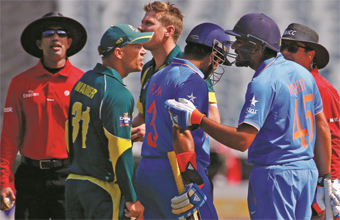
The worst incidents are generally players reacting to sledging. Recently Ben Stokes was involved in a shoving matchagainst Bangladesh’s Tamim Iqbal while Virat Kohli is adept at winding-up mostopponents. David Warner was especiallyaggrieved during India’s visit to his home country a few years ago which drew him into aggressive displays with most of the opposition bowlers.
It was therefore something of a surprise that the International Cricket Council last week tabled a proposal to allow umpires to show a red card to players for violent conduct.
The World Cricket Committee of the Marylebone Cricket Club (MCC), the guardians of the game, have become concerned at the rising number of incidents, particularly at the recreational level of the game and have therefore recommended an amendment to the Laws. If approved by the full committee these will become effective from October 1 2017.
While the technical aspects of this recommendation are yet to be decided, this will be the first time in the 229-year history of the game that players can face formal sanction and expulsion from the field of play.
However it has been agreed that‘threatening an umpire, physically assaulting another player, umpire, officialor spectator; or any other act of violence’ will be a sending-off offence that will result in a team being reduced to 10 players for the remainder of the match.
Former England captain, Mike Brearley, who chaired the meeting in Mumbai that consists of an independent advisory panel of12 former cricketers, announced that the recommendation was a response to a global survey of umpires.
It showed that a remarkable 40 per cent said that they had considered giving up because of abuse and there was ageneral feeling that behaviour was on the decline, primarily in amateur leagues.
Last year in England alone nearly ten matches were abandoned early with players subsequently given lengthy bans at hearings.
There are some suggestions that the rule could also be applied to teams that appeal excessively. In the recent series against England the Indian team (although this is not a problem exclusive to them) has been heavily criticised by commentators for the manner of their appeals. Crowding and approaching the umpire is seen as acting against the spirit of cricket and may be an area that the authorities clamp down on.
It is unclear at this stage whether the card system will be expanded to also include fast bowlers targeting batsmen. The overuse of bouncers has been on the radar ever since the ‘bodyline’ Ashesseries of 1932-3 when Douglas Jardine’s men aimed for the bodies of the Australian batsmen. The issue has been brought sharply back into focus following the death of Philip Hughes after he was struck on the head by abouncer from Sean Abbott in 2014.
Another change that has been recommended isthe reduction in size of the bats permitted. There has been a growing concernthat the fair balance between bat and ball has been erring towards the batsman with mishits frequently clearing the boundary ropes. Given that it isimpossible in most cases to expand the field of play, bats will now be limited to a depth of 67mm with edges limited to 40mm (many currently use bats up to 50mm).
Surprisingly given the punishment (underappeal) handed out to South Africa’s Faf du Plessis, there will be no adjustment to the rules for ball tampering.
It is refreshing to see a governing body implementing a global law to deal with matters affecting the lower echelons of a sport, pro-actively working to prevent it spreading into the professional game. As many sports rely on volunteers to manage and officiate games this is a positive lesson of empowerment to ensure longevity.
The image of afternoon tea being taken alongside a village green with gentlemen and lady cricketers adhering to the spirit of the game can now linger!


