

_20260813104204.jpg)




Liverpool Football Club was rightly lauded last week for becoming the first club in the Premier League to agree to pay all employees the Real Living Wage (RLW).
Of course, this does not relate to players whose income has escalated to astronomical levels over the last decade, but to match-day employees, many of whom work on part-time contracts.
The Anfield club reached this decision after negotiations with the Living Wage Foundation and the Liverpool City mayor and will introduce the higher payments before the end of the year.
This decision will effect approximately 1,000 workers and is estimated to cost the club an additional one million pounds (BD500,000) per annum.
While Chelsea and Everton have also signed up to the RLW initiatives they are yet to implement the full commitment and also sub-contract many of their match-day services.
The RLW (£8.45 per hour / 9.75 in London) is roughly £1 per hour higher than the minimum wage and was devised to reflect the actual needs of working families.
Even at the start of the current season an expose by a UK national newspaper found a number of clubs still falling short of their commitments, despite receiving even larger windfalls as a result of the bumper TV contracts amounting to £8.3bn over a three-year period.
It was only at the start of the 2016 season that many clubs had agreed to pay all direct employees, including the stewards, programme sellers and turnstyle attendants the minimum wage and so the revelation that many were not should have hit hard.
Although the crux here is that many clubs outsource these roles yet fail to ensure that these companies apply identical rules. It is not uncommon in industry to apply minimum criteria when sub-contracting and Premier League clubs should do the same.
Premier League football may be the most watched of all regular competitions in the world and, as a result, receive the highest income.
Yet, the clubs have struggled to make this wealth count on the wider European tournament scene. That fact could be about to change?
Four of the five teams present in the competition are topping their groups with the two clubs from Manchester boasting perfect records (matched only by Paris St Germain).
There was one result that stood out last week which suggests that English football may be about to start to assert some domination.
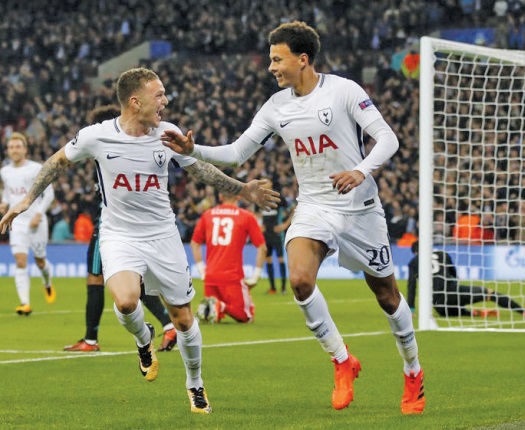
The Galacticos of Real Madrid had not been defeated in the group stage for five years, a run stretching back 30 games – until they met Tottenham Hotspur playing at a temporary home ground that is supposedly ‘cursed’!
The manner of their 3-1 victory – the largest defeat inflicted on the Spaniards since Juventus won 2-0 in 2008 – had the opposition manager Zinedine Zidane admitting that his side had been outclassed by an intoxicating combination of intensity, pace, power and subtlety.
Not bad for a side that is supposed to be a one-man team! It was surreal to watch the home crowd shout ‘Ole’ as the London team kept the ball away from their Spanish rivals!
Of course, Spurs have experienced some giddying moments in Europe before, most recently perhaps their double win over Inter Milan in the knock-out phase in 2011, before losing out to Real Madrid in the next round.
Coupled with their 4-1 league demolition of Liverpool this win, therefore, could be a watershed moment that demonstrates Spurs’ ability to compete with the best sides in Europe.
What’s more, unlike their domestic counterparts, they are achieving this quality of football with a core of English players, all of whom have risen up through their academy.
Madrid kept Harry Kane quiet leaving Dele Alli to steal the headlines with two goals. However, Eric Dier provided Spurs with a solid base while Kieron Trippier demonstrated with his pace and precision crossing from the flanks why they were willing to let Kyle Walker depart for Manchester City.
Harry Winks, just 21, dominated against his former Spurs’ role-model, Luca Modric.
The problem that Spurs will have, until they convert these wins into silverware, is that performances such as this will have the bigger clubs targeting their players.
Already Barcelona are rumoured to be keeping an eye on Winks while surely anyone wishing to prize-away Alli or Kane will have to break the world record, given the shrewd manner in which Tottenham do business.
Manager, Mauricio Pochettino, acknowledged the need to win trophies while recognising that it is the Premier League and Champions Trophy that he considers to be the main prizes.
A capacity crowd at Wembley - reaching nearly 88,000 - has started to believe.
Performance of teams from Europe’s big four leagues in the Champions League this season:
Country P W D L F A GD
England 20 15 4 1 56 17 +39
Spain 16 7 6 3 25 16 +8
Germany 12 4 3 5 17 20 -3
Italy 12 5 3 4 20 18 +2

