

_page-0001_20260903101241.jpg)




SOME of Bahrain’s most celebrated artists will be showcasing a series of their colourful canvases alongside contemporary creative talent from across the globe at a major fair in Russia this week, writes Mai Al Khatib-Camille.
The Cosmoscow International Contemporary Art Fair, which will open its doors tomorrow, features designs from more than 200 artists and 70 galleries to raise awareness about new trends as well as to educate people on a variety of artistic practices.
The annual festival of colours was founded by Russian collector and philanthropist Margarita Pushkina in 2010 aimed at bringing together home grown talent and international collectors, galleries and artists all under one roof to share their passion for painting, sculpting and other mediums.
The four-day festival will be staged at Gostiny Dvor in Moscow and among the artists showing their work will be Bahraini painters Faika Al Hasan, Dawiya Al Alaiwat and Omar Al Rashid.
They flew out from the kingdom last Monday alongside Kaneka Subberwal, founder of international art investment and consultancy firm Art Select. The work was chosen for its creativity and quality by the organising committee of experts. There will also be art pieces from the late Rashid Al Oraifi on display.
The Bahrain talent follows in the footsteps of Balqees Fakhro who exhibited 15 paintings at Cosmoscow last year which attracted around 19,000 visitors.
According to Kaneka, Balqees’s work was so well received, Bahrain ‘had to’ reapply to take part again. She said: “People walked into the fair last year and they simply gravitated to our stand. People embraced it and had so many questions.
“We applied again this year and were thrilled that four of our artists were selected to feature their work. It’s very encouraging for us and we are excited about it.”
This year Bahrain’s curated show will be called Legacies and will feature up to four art pieces from each painter. “It’s all about going back to our roots and showcasing our legacy,” added Kaneka.
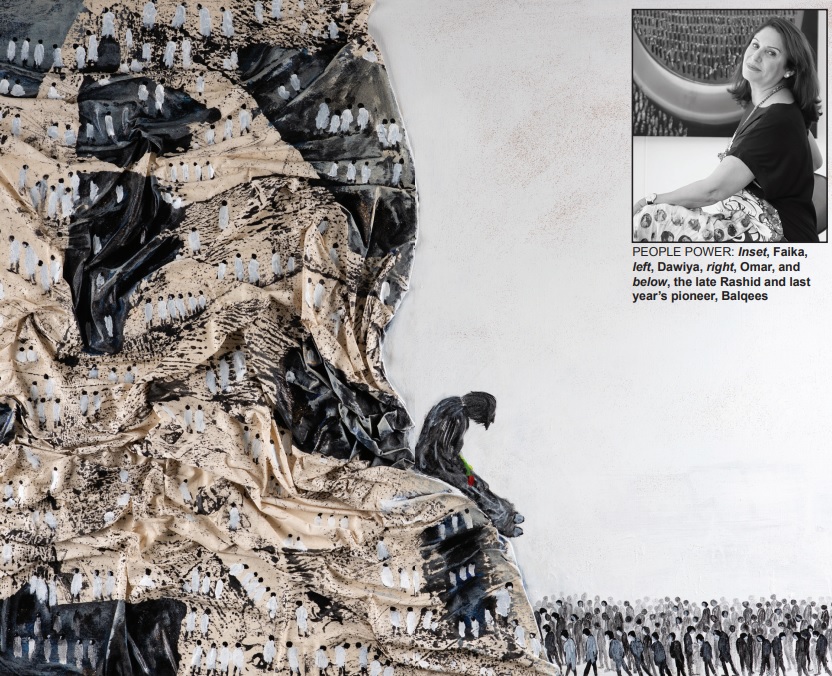
Faika, who studied fine arts and painting in Bahrain and Lebanon, will be exhibiting her fascination for raw unbleached cotton used for the bedding of her childhood, as she sees it as the fabric of life. In her paintings, the fabric is used with a message – as a visual trope, as clothing offering modesty and protection, as a container holding one’s possessions as one flees hardship to make a new life elsewhere, where once unpacked, the fabrics come out to make a new home.
Faika’s work is distinctive for its play on tens of small human figures inhabiting large and anonymous spaces. The overriding message is that of ‘our own insignificance in the large scheme of things’. Although the figures sometimes travel the canvas in groups, they are all isolated from one another.
Dawiya, who demonstrated her work in several exhibitions on a regional and international level as a solo and group participant, also shows her fascination for textures such as paper, textiles, sand and string.
Although graduating from the University of Alexandria’s Faculty of Law her natural instincts for colours and canvas made her switch to the world of art. She was deeply influenced by her childhood travels which took her to places of natural beauty. Her works are usually mixed media and minimalist but manage to create a resonance with the viewer through the sheer force of visual juxtaposition.
Muharraq-born Omar juxtaposed his emotional attachment to his heritage, customs and tradition with a conscious experimentation.Art critics suggest he distanced himself from the trend for ‘plastic arts’ and worked hard to create a genre of painting that was immediately seen as deriving from Bahraini and Islamic culture. He achieved a balance between form and content as well as originality and modernity.
Omar was first inspired by the bright, vibrant colours of the seascape and Muharraq was the first place where his passion for Bahrain customs and folklore developed. His second artistic inspiration was his mother. As a child, he monitored her movement, traditional dress and endless folk tales. It was because of this intimate association that he held women in such high esteem in his work.
His subject choice also allowed for his portrayal of intricate and detailed fabric. His female figures echoed a balance between femininity and strength which was reflected by the dominating colours and vivacious fabric. He positioned his women so that they were not portraits but instead were portrayals of symbolic women – Middle Eastern women of the past, present and future.
Rashid has left behind a reputation of being a grand master of the contemporary Bahraini art movement and a member of his family will be attending the fair in his honour.
Growing up in Muharraq as well, Rashid was deeply influenced by his surroundings and the seaside city’s heritage and rich pearling traditions. He built his oeuvre around Bahrain’s Dilmunic civilisation of 5,000 years ago and added his own modern interpretation of traditional Bahraini oral narratives.
He will be remembered as a prolific painter, collector, writer and speaker. He set up the Dilmun School of Art and was President of the Bahrain Society for Contemporary Arts and won several awards for his role in knitting Bahrain’s ancient historical imagery with his modern canvases. He is probably best known though for his private collections and establishing a movement to nurture private art museums and collections as repositories of contemporary Bahraini art.
Shaikha Maram bint Isa Al Khalifa, the director of the Office of Her Royal Highness Princess Sabeeka Bint Ibrahim Al-Khalifa, wife of the King of Bahrain and President of Supreme Council for Women, is proud of the artists exhibiting their work.
She said: “We have a wealth of talent to showcase. Bahrain is strengthening its relationship with Russia and working on commercial and political relations and now we are reaching out through our art. Art is, after all, such a universal language.
“We will be there to say that here is a country in the Arabian Gulf that has a wealth of talent and each time we take a group of artists it’s wonderful to see and hear the positive feedback.
“When people say to me ‘wow, I never thought this would come out of Bahrain’ then it compels me personally to keep showcasing our works because we have a wealth to showcase.”


