

_page-0001_20260903101241.jpg)




HIGH-FLYING Bahrain-based expat photographer Phil Weymouth set his lens skywards once again to collect another set of stunning images.
Well-known for his photographs of aeroplanes performing acrobatics at major international air shows, this time he focussed on the feathered variety whilst on a boat trip to Hawar Islands.
“The location boasts amazing birdlife as well as a variety of animals on land.
“Aircraft are a lot more predictable when they are in the air. Birds just do what they want to do!” said Australian Phil, 56, who has recently returned from official photographic duty as the UK’s Farnborough Airshow offering a brief glimpse of what is to come at this year’s Bahrain International Airshow.
Australian Phil, 56, was headhunted for the job six years ago after he worked at the Bahrain iteration, which is held in association with Farnborough. Executives took a shine to his work and invited him to England and GulfWeekly featured a selection of his work taken during his fourth event behind the lens.
This time it was the turn, or tern, if you pardon the pun, to highlight nature’s own majestic flying machines. “It was great to be outdoors in a challenging environment,” said Phil. “It takes a lot of patience and skill, I had great admiration for the top wildlife photographers.”
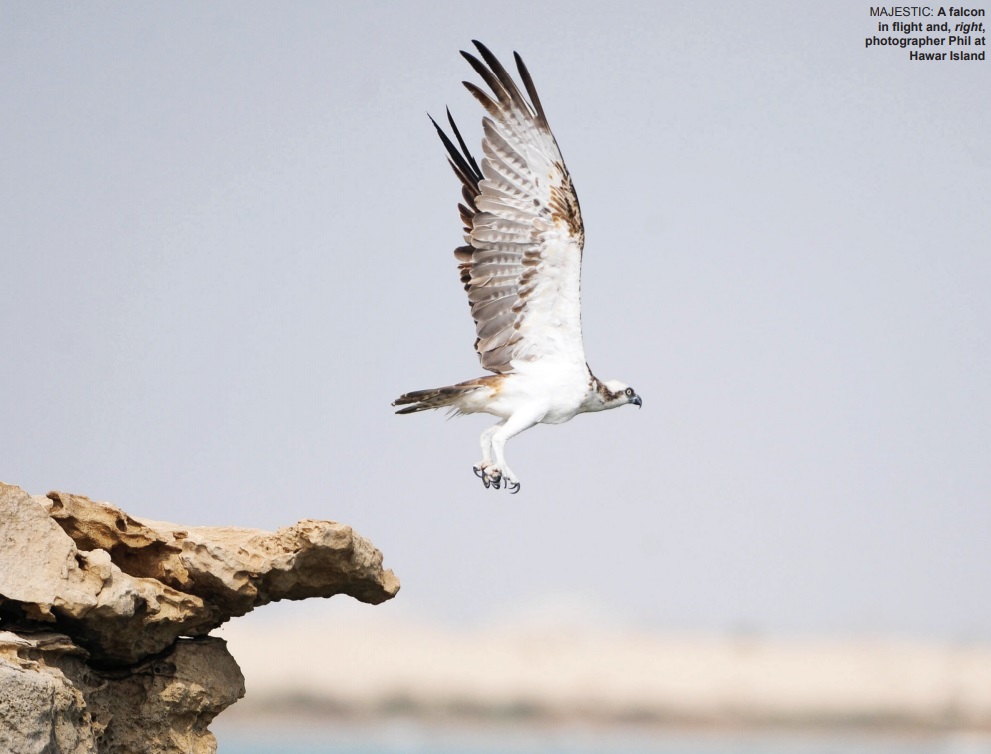
And as all professional photographers will admit, a bit of luck helps too! “There were a pair of Osprey Hawks that we really wanted to get photos of,” explained Phil.
“My favourite image from the trip is the one of the hawk soaring skywards. He was sitting on a rock and I knew he would take off when we got close in the boat.
“I’m always surprised at what you can see here. The guides on Hawar really know what they are looking for, know all the names of the birds and the best locations.”
In his younger days he worked in a variety of fields, literarily, as a ‘jackroo’ (farm hand) and tree surgeon and went on to become a chauffeur and even a cross-country ski instructor. However, his passion for photography, which started in his school years, never went away and he made it his full-time professional career, in his home state of Victoria, with Rural Press, an agricultural publication.
He soon started freelancing for large daily and weekly newspapers in Melbourne, and his work was recognised and snapped up by international press agencies including Bloomberg and Getty Images. He went on to work for the travel publisher, Lonely Planet as a photographer and photo editor and was also assigned to provide images for several books in Asia and the Middle East.
“There were always cameras around my family. My father gave me one when we drove from Tehran to Kabul in the mid-1970s. In Kabul we climbed to the top of one of the surrounding mountains,” said Phil.
“I remember there used to be a large old cannon that would be fired at mid-day. I lined the camera up, the cannon went off and I jumped up in fright, producing one very blurry photograph! We lived in Tehran for 10 years in the 70s and we were always going on amazing family adventures.
“Dad taught me so much on these trips, visiting some amazing places throughout Iran which gave me that sense of adventure and curiosity about people.
“Like many photographers, as a kid I would spend hours looking through National Geographic magazine at the stunning images published. I have a lot of photographer friends around the world, doing so much amazing work. I am constantly humbled by them.
“I first came to Bahrain after the evacuation from Iran in 1979 before coming back 13 years ago. It was time to settle down after travelling for so many years and there was opportunity in Bahrain.”
Phil also uploads scores of local images on his Bahrain Life website which are regularly featured in GulfWeekly too.
He believes his photographs help capture the essence of the kingdom at work and at play, highlighting its local and expat communities and the cultural honeypot and hive of activity of a modern kingdom at the start of the 21st Century.
Phil said: “I really enjoy the people, the workers. It never ceases to amaze me what people do for a living – in fact I spend far more time talking to the people in my images than taking their photos! Bahrain is such a microcosm of people … faiths, professions, all trying to do the same thing, make a living, and make a better life for their family and their children.
“Bahrain Life is about telling the story of our time. There’s no agenda, no position, it’s simply a clear lens on the everyday life of everyday people. It’s been an eye opening and inspiring experience for me. I hope it is for other people.
“When you get over the age of 50 you suddenly realise that 100 years is not such a long time. Maybe 100 years from now people will look at these photos in amazement of how life was in Bahrain at the start of the 21st Century. It’s a photographic narrative of life today – it is this moment in time.”
His latest wildlife images will feature on the Hawar Islands resort website and on social media, a destination which has recently been highlighted in our sister publication, the Gulf Daily News.
There are believed to be around 20,000 Socotra cormorants nesting at an island called Suwad Al Janubiya (South Suwad), which is part of the archipelago comprising of six major and more than 30 smaller islands of various sizes with a total land area of 50 sq/kms.
Once the subject of an international boundary dispute between Qatar and Bahrain, the islands were awarded officially by the International Courts of Justice to Bahrain in March 2001.
The Socotra cormorant species, known locally as Allooh, falls under the ‘fully protected’ category in Bahrain, and the colony is repeatedly plundered by egg thieves and climate change remains another factor driving down numbers.
The substantial tern colonies include Arabia’s only documented colony of breeding Caspian Terns Sterna Caspia. The Sooty Falcons Falcon Concolour, the Osprey Pandion Haliaetus, and the tens of thousands of migrant wader gulls and flamingos, all add to the importance of the islands from an ornithological viewpoint.
As for the prize mammals, the origin of the gazelles, for example, on Hawar is not known. The herd could well be a remnant of Bahrain’s native gazelle population long thought lost or contaminated by the introduction into Bahrain by other Arabian species. Current numbers are thought to now total close to 300 individual animals.
Hawar has been described as a ‘bird-watcher’s paradise’ and the hotel as a ‘true nature retreat’ in Bahrain. There are also Arabian hares, jerboa – hopping desert rodents – and the desert-dwelling goat species called the Nubian Ibex, as well as spinney-tailed lizards.
The resort offers various seasonal tours although advanced bookings are required, with prices varying too.
Other delights in the water around the islands include the Dugong, a marvellous marine mammal, believed to be part of the second largest herd in the world of this endangered species.
Although only the largest island is named Hawar, the name Hawar or Hawar Islands is locally often used collectively, to describe the entire archipelago. It has also been reported that an official panel had been formed to further develop the area for tourism. The Southern Municipal Council first proposed a bridge to the islands, located around 26km southeast of the mainland, in April.
l Visit https://philweymouth.wordpress.com for more examples of Phil’s work.


