


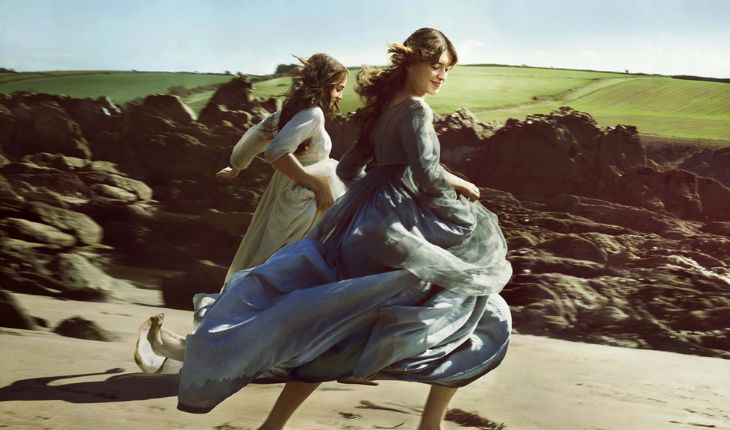
THE new Jane Austen film adaptation Sense and Sensibility is out now in theatres.
It stars Daisy Edgar-Jones and Esmé Creed-Miles as the Dashwood sisters – the pragmatic Elinor and the passionate Marianne – as they navigate financial hardship, social expectations and heartbreak in 19th-century England.
The duo and their youngest sister Margaret (Bodhi Breathnach) move to a modest cottage after losing their late father’s estate to their step brother and his greedy wife Fanny (Stacy Martin).
While navigating the sudden change in their lives, the pair go through thematically different love stories, with Elinor representing sense, reason, restraint and quiet composure, and Marianne representing sensibility, intense emotion, romance and impulse.
Screenwriter Diana Reid and director Georgia Oakley discussed their creative process to bring the timeless classic alive on the big screen for the first time since 1995.
The former described her approach to be ‘respectful but not reverent’, saying she wanted to retain the period-accurate language, but was open to changing what she felt didn’t resonate.
In the book, she noted, Marianna goes through more character development than Elinor.
“Marianne has to just learn sense and her whole personality changes to become more like Eleanor,” she said in an interview.
“With this adaptation, what was more interesting to me was the symbolic nature of Sense and Sensibility. I loved the idea that they both had to change and that they both had to acquire the other’s qualities in order to become their true selves,” she added.
For her part, Georgia discussed historical accuracy versus interpretation conversation, which plays a huge part in the process of producing classical films.
“In terms of direction, everything kind of comes down to instinct. I am drawn to a slightly more naturalistic feeling and that is what kind of excited me when I received the script. It felt like all of the characters were so fully formed and it was so propulsive. I was intrigued what it would be like if I put my stamp on it. So with that, we leant more into low lighting and focusing on nature, because that’s how I instinctively wanted to tell the story,” she explained.
Georgia also expressed how she rejected bonnets, which she says are synonymous with Jane Austen.
“I think the question of historical accuracy is a bit wooly, anyway. I had a conversation with my costume designer early on to say I didn’t want any bonnet unless they were elevated in some way,” she added.

Digital Edition
Flip through the latest issue of Gulf Weekly.
Click here to view flipbook edition
Click here to view PDF edition

Contact Us
Al Hilal Publishing & Marketing Group
PO Box 1100,Manama,
Kingdom of Bahrain
Click here for Contact Details