


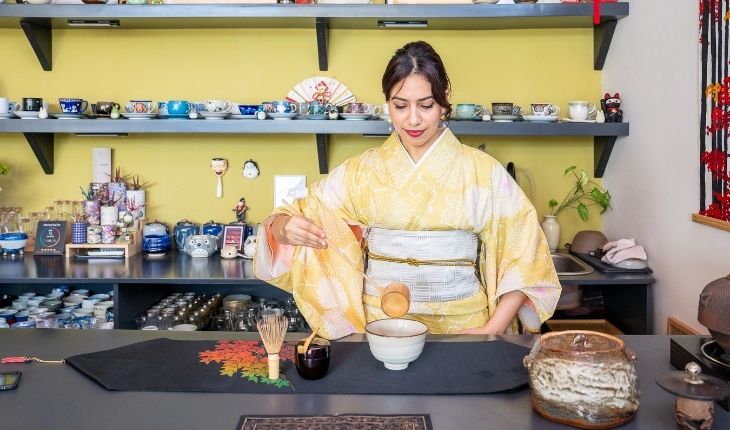
In a world often divided by differences, sharing a cup of tea can become a powerful symbol of unity. In the same spirit, Bahraini entrepreneur Budoor Steele continues to use her passion for culture to bring people across the globe together.
The certified tea master and instructor is set to demonstrate the traditional Japanese tea ceremony in Paris this week, as part of her campaign entitled A Bowl of Peace – from Bahrain. The events will take place at the Michelin-starred Chakaiseki Akiyoshi, as well as Château De Bussemont - a Bahraini-owned establishment.
The Paris edition follows Japan and Hawai editions, all built around the philosophy of ‘peace through a bowl of tea’ – a core tenet of Sadō (‘the Japanese Way of Tea’).
Additionally, the project is a cross-cultural initiative where Budoor, who also holds a Master’s degree in Japanese Humanities from Kyushu University, will be showcasing the kingdom’s rich heritage on an international stage.
“There is so much of effort that has gone into this third edition and I am so excited for it,” Budoor told GulfWeekly.
“The kimono that I’m wearing is partly woven in Bahrain. I had the belt sown by an artisan from Al Naseej Factory in Bani Jamra, who added our traditional Al Naqda (gold thread) embroidery on it so, it is really going to carry the essence of Bahrain. Even the bowls that I will use during the demonstration are made by our local pottery artists,” explained the recipient of the prestigious Minister’s Award for Overseas Promotion of Japanese Food.
The creative entrepreneur was recognised by Japan’s Ministry of Agriculture, Forestry and Fisheries in December last year, making her the first Bahraini and only the third recipient in the Middle East to receive the recognition.
Recounting her eventful journey, Budoor revealed how a chance encounter with the ‘Japanese Way of Tea’ got her to formally study the ‘art’ of Japanese tea making and the culture, which she says has made her more mindful.
“Japanese tea making is rooted in Buddhist philosophy, which makes you view life differently. You slow down and appreciate your surroundings. Doing it on a day-to-day basis changes your perspective,” she added.
Giving the GulfWeekly team a private showcase of the tea ceremony, Budoor noted how every element, from the slow hand motions to the bowls used, is deliberate, nodding to the mindfulness embedded in the culture.
“The ceremony is meticulously designed and taught or ‘handed down’ from the teacher to the student – there is no book to memorise it from. In Japanese, we say ‘the memory of your hands’, which means we practise it until it comes to us effortlessly,” she explained, highlighting that the idea is to be fully present in the moment.
There are around 32 different ways to perform the tea ceremony, the official Japanese Cuisine Goodwill Ambassador revealed, depending on the season or the occasion and it takes a lot of time for one to reach to an instructor level.
The local talent recently became a Jun-kyōju or ‘associate professor’ in Sadō and aspires to educate more people in the region about the art and the culture. She holds a formal teaching license from the prestigious Urasenke School of Tea in Japan.
She currently teaches students at Chawan Japanese Tea House, tucked away in Andalus Garden, Adliya. The carefully curated space is an extension of Budoor’s passion for Japanese culture and features a tea room, replete with tatami mats and cushions reflecting traditional designs – all honouring her journey.
“This space is mostly made for the tea ceremony or private tea experiences. We also teach about matcha and tea. When we don’t have bookings, it’s open for people to experience the atmosphere of the tea room. We also have a cafe section where we serve tea drinks, inspired by seasons in Japan. Our Ominaeshi drink, for instance, nods to an autumnal flower,” she added.


Digital Edition
Flip through the latest issue of Gulf Weekly.
Click here to view flipbook edition
Click here to view PDF edition

Contact Us
Al Hilal Publishing & Marketing Group
PO Box 1100,Manama,
Kingdom of Bahrain
Click here for Contact Details