






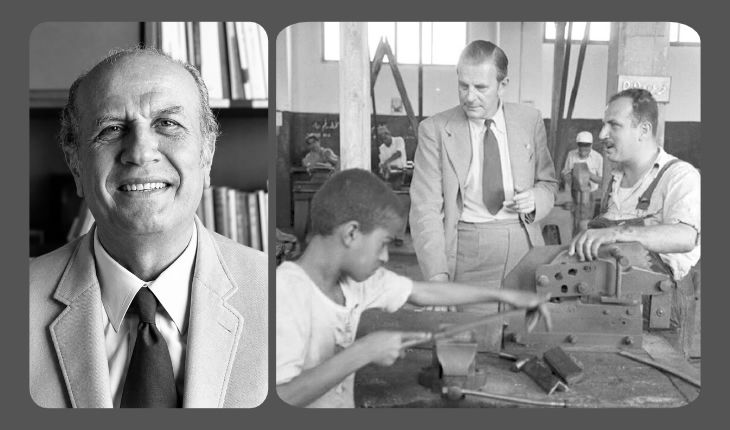
A booklet commemorating the life and work of educational pioneer Saeed Tabbara is set to be released tomorrow, November 27, on the 10th anniversary of his passing, honouring his many contributions to the kingdom’s progress.
The 32-page compilation, in both English and Arabic, will highlight the milestones of his career and his role in developing the skilled workforce that supported the growth of Bahrain’s industrial sector, featuring memorable visuals.
The launch follows the educator’s 503-page biography entitled ‘Saeed Saeed Tabbara: The Architect of Technical Education’, which was published in 2018.
“The last book was in Arabic and we wanted to share our father’s journey with our non-Arabic speaking friends, which is why we are launching the booklet,” Saeed’s son Dr Khaled Tabbara told GulfWeekly.
“It is a tribute to his memory, which remains deeply cherished by his wife, children, grandchildren and great-grandchildren. Though he is no longer among us, his presence endures in our lives and in the memories of all those fortunate enough to have known him,” he added.
Saeed arrived in Bahrain in 1940, at the age of 21, carrying an industrial diploma from the National School of Arts and Crafts in Beirut. He began as a teacher at Manama Technical School, now the popular Crafts Development Centre, which had only 25 students then. By 1946, he was appointed as its principal.
Retired associate professor of immunology and medical education leader Dr Khaled highlighted that his parents influenced him and his sisters immensely, encouraging them to pursue successful careers of their own.
“He was a devoted father and mentor to us, and, together with our mother, Aisha Ibo, he instilled in us the values of education, hard work, commitment and good character,” he said.
Ms Ibo continues to inspire her children, grandchildren and great grandchildren at the ripe age of 104.
Recounting his high school years, Dr Khaled said: “We lived all our lives on top of the school and could see his office and a good part of the building from the windows of our house. As a teenager, I visited the workshops and found them interesting.”
Over time, Saeed expanded the school’s specialisations to include electronics, motor vehicle maintenance, an aluminium foundry and more while modernising workshops and equipping them for practical training. Furthermore, he enhanced the curricula to meet global standards.
Hundreds benefited from his many contributions, which included initiatives to improve students’ English language skills, sponsoring outstanding graduates to study in the UK and introducing evening training programmes for workers without formal education.
These programmes coincided with a period of major industrial investment in Bahrain, from the late 1960s to the late 1970s.
Saeed served on the Gulf Technical College executive committee and was later appointed vice president of its successor – the Gulf Polytechnic. When Bahrain University was established in 1986, he was a member of the board for eight years, helping to advance engineering and technical education.
“Not every achievement that shapes a nation’s history is measured by concrete or steel alone. Some leave a quieter and more enduring legacy by giving people the knowledge and skills to shape their nation’s future,” Dr Khaled noted, adding that his father’s life and work were dedicated in pursuit of this belief.
