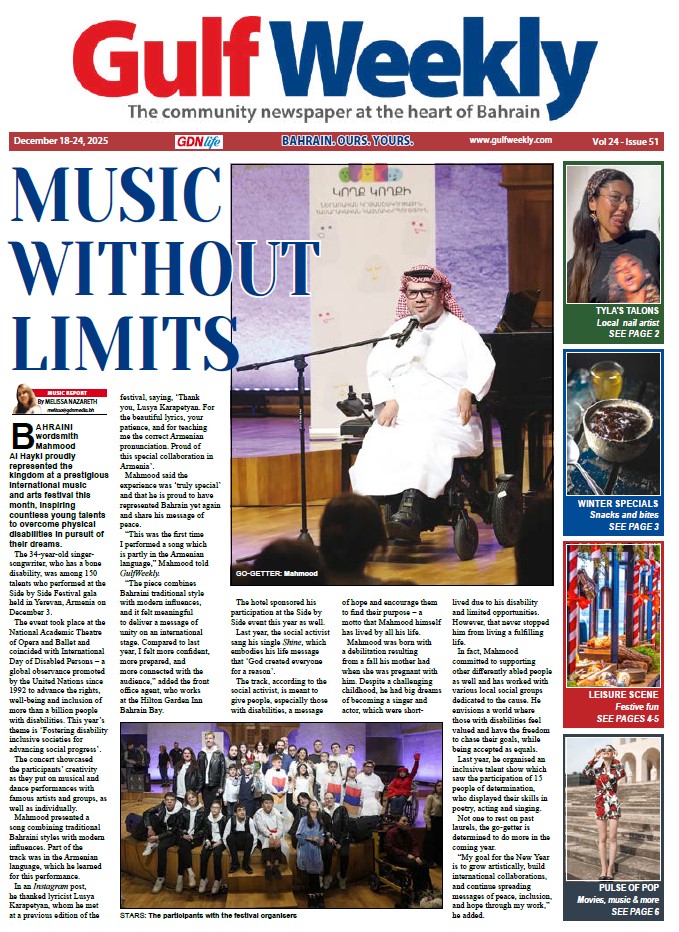
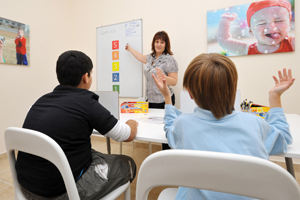
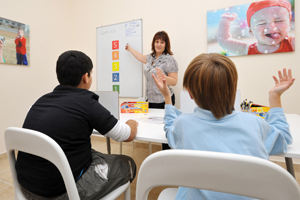
A specialised speech therapy centre offering the latest methodology and practises in communication disorders has opened in Bahrain.
It has proved to be so popular that within the first three months of operation it is providing treatment for more than 80 clients from the age of nine months to 64 years.
The centre's opening comes at the same time an Oscar-bound British historical drama The King's Speech has been inspiring stutterers and raising public awareness of speech disorders like nothing else before it.
The movie tells the story of King George VI (Bertie) who reluctantly assumed the throne after his brother abdicated. Plagued by a dreaded stutter and considered unfit to be king, he engaged the help of a speech therapist. Through a set of unexpected techniques, and as a result of an unlikely friendship, Bertie was able to 'find his voice' and boldly lead the country through war.
The NANS Centre in Barbar has been set up and is run by Michelle Eral, Speech Language Pathologist-Clinical Director, who boasts 15 years of professional experience.
It is part of the NANS Group - a Bahrain-based company with diverse interests from media to real estate, which is providing financial, business development and accounting support to the establishment.
With therapists Katie Martin, Susan Eberly, Emma Woods, Danah Younis and Melissa Bloomer, the centre is offering treatment in different areas of communication challenges including speech, language, voice, hearing, fluency and social language.
They also provide assistance on related issues concerning lisps, stuttering or stammering and to autistic children. The centre's oldest patient is a stroke survivor who is learning to talk again.
Therapists also visit pre-schools and nurseries to help school faculty in communication issues related to younger children.
Michelle, 42, said: "I noticed that there was a substantial need for therapists in Bahrain. I used to get calls from families before this institution was set up but I was clear that if I was going to do something I would do it the right way."
She also believes that the predominant use of nannies in the home could also attribute to the several causes of speech problems among children on the island as it lessens the need of a child to look out for himself and reduces his communication requirements.
The other reason is that the nannies often speak a different language or do not have a good grasp of the child's primary language and thus are not ideal role models.
Michelle, from the US state of Wisconsin, has a bachelor's degree in communication disorders and a master's degree in speech and language pathology. She has specialised in brain injury, community integration, paediatric through geriatric needs and also technology in therapies. She lives in Bahrain with her husband, Joe, and has three children, Carissa, nine, Jake, 18, and Cooper, 22.
THE challenges expat children face coping in a multi-lingual environment is just one of the many being addressed at a pioneering new speech therapy centre in Bahrain.
Shyness maybe the simple cause but for other youngsters it is imperative to identify a learning problem or difficulty at an early stage.
"Everything we do is based on standardised norms," said specialist Michelle Eral. "We use subjective information to further our investigation but there are certain things that a child should be doing at a certain age. For example, by the age of two they should have 30 words to their vocabulary. When they go to three years they should have a thousand words and that is a big jump. Obviously in this part of the world you have many, many different languages and so we have to tweeze out what is a difference and what is a disorder.
"So, we look at a child's first language and if it is not what he or she is getting educated in then there is going to be a gap there. Most children have an unbelievable ability to adapt to languages but some children struggle. Then you have to decide on what is going to be your primary language and get the child educated in that language.
"I am not a fan of cutting out a second language from a child's home but you have to just look at what their educational medium is going to be and what is best for the child.
"Typically, such children will have difficulty socialising. It is more so with children who talk with a lisp.
"The important thing to remember is that the younger they are the sooner these difficulties can be addressed. The longer a problem gets ignored the more it becomes a habit, which is much harder to break."
In the initial screenings, which are free of charge, interactions can take from half-an-hour to an hour and could also require three or four visits depending on the attention span of the child.
"After a lot of questions we come to a conclusion whether or not what we are seeing is developmentally appropriate or whether they need further type of intervention," explained Michelle.
"At times we advise parents to do one or two things at home and come back for a revisit after a couple of weeks.
"When second language is the issue we test the child in both languages. We do not just have Arabic speakers; we have English, Danish, French and many others. So, we test first in the first language and then the second language before we lay them down in a continuum, and if their first language is age appropriate and their second is way down then it is a difference, not a disorder.
"We then talk to the parents about their options and opportunities. We often come across cases where parents are educating their children in their second language and a grasp of the language just may be delayed, so they are struggling in school because of this difference."
Along with customised individual therapy, the centre also offers group therapy, which emphasises on social skills using games, video taping and role playing. Another group called 'toddler talk' - for a maximum of six to a group - simulates a mock pre-school for children aged two to six years.
Michelle stressed that it is not a school and children are taught to break barriers through sharing and playing. She added: "These are for children getting into pre-school or struggling in pre-school. There are some who don't talk because they are 'selective mute' and the problem for parents is how they can to get into a school!
"In this group setting we have an early childhood specialist along with a speech therapist and as many aids as we need to allow the children to be successful.
"The sequence follows that in a normal pre-school - free play, reading time, art and craft time, circle time, snack time and we wrap the support around them to help these children to be successful and then we back off the support and teach them independence.
"A lot of pre-schools send children here who are struggling. We even allow parents to shadow and see the teaching method. It is a very, very successful and wonderful programme."
Therapists work with their clients on individualised plans in rooms painted in an energising orange shade and that which has minimal distractions.
The centre has recently invested in an iPad that is supported with special software to help children who cannot speak at all.
She added: "One child, who could not express anything before, is now pushing buttons to say what he needs with different words. The software will talk for the child.
"We refer to things as noise around here. There is olfactory noise, visual noise, tactile noise and auditory noise.
"We first work on helping the person in discriminating sounds. We have to train their ears on what is a good and bad sound. We then work on sounds in isolation and later go on to syllables, words, phrases and sentences and later into conversations.
"We have to first tweeze out a lot of things ... why the person cannot pronounce a sound - whether they are not aware of it or is it a hearing problem?
"I had a child who would not correctly place his tongue. So we put peanut butter on top of his mouth and encouraged him to touch it with his tongue. We have to just tailor it to what that child is doing and why they are doing it. And, we encourage parents to be part of the therapy sessions."
Individual sessions at NANS are available at BD22 for half-an-hour and BD33 for an hour.
Michelle says there is no formal instruction or advice offered by experts as to when a parent should seek help. She believes parents should trust their own intuition.
She added: "If children are talking at home and are not talking at school it may be a case of shyness. However, you should seek help when a child is clearly frustrated due to not being able to communicate. Seeking advice at an early stage from doctors and teachers are also great first steps in identifying if there is a need.
"It is better to be safe than sorry, as early intervention is always best to help prevent a compounding problem."
WHAT THE PARENTS SAY
MUM BECKY: My son Zach is three-and-a-half and has delayed speech. We have been going to the NANS centre since it opened. We also go for 'toddler talk' sessions and have just seen an occupational therapist. It has been great here as it has helped Zach in his social interactions ... he has improved and is getting better and better.
MUM EILEEN (has an 11-year-old son who had a problem with articulation and a mild lisp): I have lived in Bahrain for 20 years. After my son showed signs of a speech impediment, we made endless visits to speech therapists and doctors to address the issue. He was finally accurately diagnosed by Michelle and the therapy that followed resolved his problem. They encouraged my son to practice the exercises independently and gave him the skills to overcome his impediment.
PRINCIPAL VIEW
Eleanor Benson, Little Gems Pre-School: We occasionally see children at the school with speech problems. They either come to the school with a pre-diagnosed delay or condition or we may pick up on a problem as the child progresses through the school.
We have children in pre-nursery as young as 21 months so when they first start school their language is still developing. Between the ages of two to two-and-a-half we would expect the children to begin using three or four word sentences and have a vocabulary of between 50 and 100 words; any children falling below this expectation would be monitored and if necessary the parents would be invited in to talk to the teacher.
The NANS Centre has been a blessing to be honest. Previously there were only one or two specialists on the island and they were often fully booked up and unable to take on new cases; so Bahrain was desperately in need for a centre that has the facilities and qualified staff to properly assess these children and give them the help that they need.