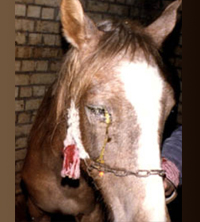
Glanders, the equine disease which has devastated the kingdom’s equestrian community and looked close to being eradicated from the kingdom’s shores, has reared its ugly head again.
Two horses from the Dilmun Stables in Saar have tested positive to the killer bacterial infection and the results are awaited on the condition of a third pony following an inconclusive finding.
The movement ban on horses across the island has been extended for another four months and the endurance horse riding competition planned as part of the GCC Games’ eleven disciplines was swiftly withdrawn from the Bahrain 11 programme of events which have been reduced to 10.
Whilst there are conflicting reports over the numbers of horses and ponies destroyed after testing positive to glanders, officials state ‘more than 70’ horses have had to be put down since the outbreak in early 2010.
Over the summer it appeared that the battle against glanders was being won, after three rounds of testing involving every horse and pony on the island came through as ‘negative’ ... until just a few weeks ago.
Experts say that testing in the immediate area will have to continue and the chances are that Bahrain will not be officially declared ‘glanders free’ for at least another 14 months because international authorities demand a six-month period of grace after all retests have returned negative ... provided no new cases are discovered in the meantime.
The disease, caused by the highly-infectious bacterium burkholderia mallei, occurs primarily in horses and can stay dormant from three weeks to eight months, or in rare cases even longer.
Strict measures were introduced across Bahrain following the first outbreak and popular show jumping events were cancelled. At the time the Dilmun Stables introduced some of the most stringent measures in the kingdom in an attempt to keep the facilities free of the disease.
However, the stable team’s best efforts were in vain after two horses tested positive last month and were subsequently put down.
The blood samples were sent to the Central Veterinary Research Laboratory (CVRL) in Dubai – one of the only two authorised laboratories in the world certified by the Office International des Epizooties – World Organisation for Animal Health (OIE) in Paris for testing glanders.
Dr Ulrich Wernery, scientific director of CVRL, said: “In Bahrain we have tested 4,000 horses and donkeys twice. The third round of testing was coming to an end when sadly the two horses tested positive.
“All positive cases, numbering more than 70, have been destroyed. The good news is that we are close to reaching the end of the problem. The outbreak has entered the last stage, in my opinion.
“There were no cases in donkeys. There were very few cases in camels ... very negligible, but they are all clear now.
“Part of the island is free. Only this particular area and those surrounding it will need to be re-tested.” Dr Wernery praised the Bahraini authorities’ efforts in tackling the problem which started when a horse imported from Kuwait was found to be carrying the disease. Since then, all horses in the kingdom have been implanted with micro-chips containing all relevant information.
Officials at the Ministry of Municipal Affairs & Urban Planning Agriculture Affairs have told GulfWeekly they were ‘deeply shocked’ by the latest outbreak and were in contact with international bodies about the situation.
A special necropsy hall to conduct post-mortem examinations on the animals and an incinerator has been installed in Bahrain to dispose of the infected animal corpses. A Bahraini vet, Dr Fajer Subah Al Salloom, has also been trained by the CVRL to conduct tests for glanders. Dr Wernery added: “There has been excellent co-operation between Dubai and Bahrain. The process of trying to contain glanders has been a long process. There were many shortcomings to start with and several have been resolved.
“Many positive steps have been taken including a strong improvement in proper quarantine facilities. I have personally seen all these facilities and am very pleased. They have done a good job.
“Most importantly, everyone should learn from this situation. There are many animal lovers in Bahrain and a large population of horses. Bahrain needs to establish a strong veterinary service with an equine hospital and a high-tech laboratory complex.
“There has been a major financial implication because of the testing and a strict import-export regulation can only help avoid such a situation in future.”
Dr Wernery said the only way forward is to continue testing and re-testing horses in the affected stable and areas surrounding it. He said: “It is a complicated disease and the bacterium takes time to incubate and can remain dormant in an animal for up to eight months.
“After the last round and once all horses are tested negative, an expert from the European Union will check all the papers and only then will the country be declared ‘glanders free’.”
Dr Wernery reiterated that the disease is so contagious it can be passed simply on the soles of shoes and all stables should continue following strict rules of not sharing troughs and not moving horses between stables until the horses have tested negative twice.
He also said that adults and children are not in danger as long as they do not come in contact with any nasal discharge or the pus of an infected animal.
The outbreak has stunned management, grooms, owners and riders at the Dilmun Stables which runs a popular in-house show jumping league, riding and stable management classes and has invested heavily in recent months upgrading its facilities.
Alec Peck, a member of the Dilmun Club’s executive committee, confirmed that two of its stabled horses were put down after testing positive for glanders. He said: “All the other horses have been further tested. The test on one horse is ‘inconclusive’ and we are awaiting results of a further test.
“We are following all the rules and guidelines laid down by the authorities, exactly as we have done in the past.”
One owner, Neil Gunby, who works in Jeddah, and has a horse stabled at the Dilmun, said: “We are very vigilant and disinfectants are always used. Everyone is waiting for more news and every horse owner is worried; it is not just me. This is the last place I would have considered suffering from a glanders outbreak – no one is more surprised than me.”
Meanwhile, the latest outbreak has raised a hornet’s nest on the social networking site Facebook page ‘Stop Glanders in Bahrain’ which is being used by the horse and stable owners in the kingdom to share information about the disease.
Tempers have been running high with many members seeking more information from the stable and others raising concerns about horses from other stables being ridden around the island despite the risks.
Shortly after the first reports of the infection spreading across the island there were mass protests by the equestrian community urging more action to be taken by the authorities to tackle the disease.
Jerri Taylor owns two show jumping horses worth several thousand dinars stabled at Shakoora Stables and Gulf Stables. She said: “We have to come together as a group to find a solution to this problem. People have to follow rules. Disinfecting is a painful process ... we have to wash hands with soap before and after being with our horses. We have to change clothes and shoes before we go to another stable and most importantly everyone must follow quarantine restriction.”
The administrator of the ‘Stop Glanders in Bahrain’ page has responded saying: “I’ll soon update this page with more information. In the meantime, PLEASE stop fighting each other.
“We are all in the same situation, we are all horse owners, we are all very upset because we thought that we won the fight against this awful disease – and yes, we found currently new cases. It’s bad enough for all of us. We are dealing with a disease – it has its own ‘rules’ and we are really doing our best to find out how it could happen. All contact horses got immediately re-tested and we are waiting for the results. Let’s pray that the other horses are all fine!
“The best thing that everybody can do at the moment is: keep your horses in your stable, don’t visit other stables and don’t touch other horses, use disinfectants in front of your stable and also disinfect your hands. If you see horses hacking, please inform us.
“It’s not helpful that our office is daily full of people who want to move their horses. There’s a movement ban in Bahrain and we are spending hours every day to explain to people why they can’t move their horses – and they don’t WANT to understand it. Please let us do our work – the most important thing is to re-test all horses as fast as possible.”