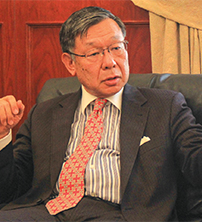
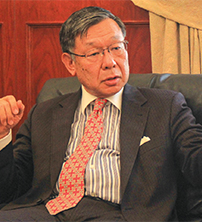
JAPANESE Ambassador to Bahrain, Shigeki Sumi, is preparing for one of the world’s toughest diplomatic assignments in battle-scarred Ukraine and hopes to spread the warmth and kindness he has experienced in the kingdom to those afflicted by its bitter conflict.
Ambassador Sumi, 61, and his wife Tomoko, 52, will depart on September 29, leaving behind strengthened bi-lateral relations thanks to their ‘pleasant and memorable’ three-year spell in the kingdom.
He said: “I have enjoyed my time here and met some wonderful people. Bahrainis should be incredibly proud of their hospitality and friendship as well as their traditions and history.
“Going to the Ukraine is both an honour and a challenge and I’m very proud to, maybe, play a small part in helping in the current situation. I hope not only for peace but also for justice; peace is easy, justice is difficult.”
The situation in Ukraine has been well documented in recent months in the international media.
To backtrack, many Ukrainians turned on ousted president, Viktor Yanukovych, who chose to back out of a free-trade deal with the European Union in favour of closer ties with Russia.
As a result, protesters took to the streets, culminating in Mr Yanukovych fleeing Ukraine and the appointment of an interim government.
Shortly after, Russian troops occupied the southern Ukraine province of Crimea, prompting a tense stand-off with Western nations.
Ukraine, suffering from a foundering economy, plunged into further chaos when Russian-speaking militias attempted to separate their home cities, with what appears to be Russian military help.
There is, however, a flicker of hope as a fragile ceasefire was agreed at the weekend by the new pro-European Union Ukrainian government and pro-Russia rebels in the east of the country.
Ukraine’s President Petro Poroshenko said there should now be talks about a long-term solution to the conflict, which has claimed more than 2,600 lives. However, the rebels said the ceasefire had not changed their policy of wanting to separate from Ukraine.
As he makes the transition from Manama to Kiev, Ambassador Sumi hopes that the on-going dialogue in Bahrain, although at times often turbulent, will serve as an example to the people of Ukraine of attempting to build bridges.
He said: “Bahrain’s willingness to engage in a dialogue after the unrest in 2011 is a testament to its strength and could serve as an example to the Ukraine which is experiencing its own conflict that will hopefully be resolved soon.”
Meanwhile, Ambassador Sumi revealed to GulfWeekly that Japan has pledged an estimated $1.5 billion of economic assistance to Ukraine, which he says could be used to help with economic reform and to assist with cleaning up its environment, which has suffered greatly as a result of industrial waste being dumped into its rivers when it was under communist rule.
The country’s stability was further rocked after the Chernobyl disaster, a catastrophic nuclear accident that occurred on April 26, 1986 at the Chernobyl Nuclear Power Plant, which, at the time, was under the jurisdiction of the Soviet Union. An explosion and fire released large quantities of radioactive particles into the atmosphere, which spread over much of the western USSR and Europe.
The Chernobyl disaster is the worst nuclear power plant accident in history in terms of cost and resulting deaths, and is one of only two achieving the maximum classification on the International Nuclear Event Scale, the other, ironically, being Japan’s Fukushima Daiichi nuclear disaster in 2011.
“The relations between Ukraine and Japan have only grown stronger in the context of dealing with the aftermath of a nuclear plant accident,” explained Ambassador Sumi.
“In terms of Japan’s pledged humanitarian assistance, the money will go to the reform process of the government and helping to clean up the rivers which have been contaminated because of drainage problems and by industrial waste. We want to help get the country back to economic stability and prosperity.”
In terms of moving to such a conflict-ridden country Ambassador Sumi says his experience of coming to Bahrain shortly after the civil unrest had given him a valuable insight into his new role.
He said: “I knew about the situation in Bahrain before I came and I never worried about my safety. And I don’t worry about my safety in my new position either.”
His new station will be in the Ukrainian capital, a place he holds in high regard for its rich history. He said: “I visited Kiev eight years ago and it was one of the most cultural cities I have been to. It has beautiful churches, local parks, the Kiev Opera Group and Kiev Ballet.
“I love ballet and opera and during my time in Bahrain I have been amazed with the National Theatre.”
Ambassador Sumi is confident bilateral relations between Japan and Bahrain will continue to flourish when he leaves. “I hope my successor will expand our relationship further so that both sides see each other as indispensable,” he said.