Bahrain National Museum is celebrating its 25th anniversary by taking the kingdom’s rich history out into the community, showcasing Bahrain’s culture and unveiling some of its collection of ancient treasures that have yet to see the light of day.
The centre, which was one of the first modern museums in the Gulf region, opened its doors to the public in 1988. It has a collection covering 6,000 years of the island’s colourful history but, sadly not enough space to feature it all.
Rashad Faraj, acting director of museums, said: “Between the 1950s and 1960s there were an enormous number of artefacts found in Bahrain. It was so substantial that something had to be set up to showcase it.
“A plan was set into motion through the United Nations Educational, Scientific and Cultural Organisation (UNESCO) and other international agencies for the establishment of a modern museum in the region, in Bahrain.
“Since 1988, we have continued to discover more and more artefacts and we are constantly playing catch-up.
“When the museum was built 25 years ago it was envisioned as a home not only for archaeology. It featured natural history, ethnography, models, a life-sized experiential walk through the burial mounds, documents, manuscripts and fine arts.
“But, we still have a massive amount of artefacts in storage. So much so, that we could probably fill another three, possibly five, museums with what we have.
“One of the things we are looking to do to solve this multi-faceted problem is expand away from centralised museum structures where everything is housed under one roof.
“We are looking to increasingly decentralise and move away from monolithic museum structures to more interactive site museums, visitors’ centres and things that are collocated at the actual sites which allow tourists to see and learn more.
“We are trying to re-inject culture into our society and raise awareness of our cultural history, backgrounds and materials that we have here.”
The proposed sites being worked on include the Saar settlement, the visitor centres at Barbar Temple and Al Khamis mosque, the Museum for Modern Art, the National Postal Museum, the Pearl Museum and the Manama Souq to name a few.
Mr Faraj said: “From a tourism element you can visit a lot of these sites and have great experiences as you go along. We have already seen this with the museum at Qalat Al Bahrain, which is a fantastic little structure, very well laid-out with many levels to it.
“When you walk in and see big walls on the side those are actual stones taken from the site and built in the correct historic time frame. It’s one of those places you can spend five to 10 minutes or two hours in.”
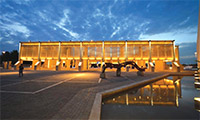
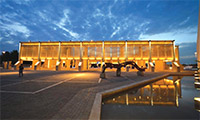
According to Mr Faraj, the museum was always envisaged to stand at the heart of the Civic Centre that would act as a social and cultural hub for the people of Bahrain.
A quarter-of-a-century later that idea reached fruition, thanks to the efforts of Minister of Culture Shaikha Mai bint Mohammed Al Khalifa, with the opening of the National Theatre. “Until then we had the museum with a lot of empty space around it,” he explained.
The Civic Centre today houses a Cultural Hall, an Arts Centre, the Arab Regional Centre for World Heritage, the MOC, the National Museum and the National Theatre.
“We have a whole bunch of projects to revitalise cultural and historical aspects of Bahrain’s history. We are also looking at upgrading the permanent exhibition halls,” Mr Faraj revealed.
The museum, which is composed of two attached buildings, features approximately 20,000sq/m of floor space. It includes six permanent exhibition halls, three temporary exhibition halls, a library, classrooms, an auditorium, a gift shop and a café as well. The centre also houses the administrative offices of the Ministry of Culture until a new headquarter is built. There are also curatorial research areas and storage spaces for parts of the collection not on display.
The museum’s exhibition halls, located on the ground and first floor of the main building, includes the Hall of Graves, Dilmun Hall, Tylos and Islam, Customs and Traditions, Traditional Trades and Crafts, Documents and Manuscripts and Art Gallery.
Mr Faraj said: “Whatever was less relevant in the museum we removed. We replaced older exhibits with travelling exhibitions that come from abroad. It’s not just a museum; it’s effectively a gallery of sorts because we have exhibitions like Russian and Chinese textiles, masks, dolls, sculptures and art from all over the world coming in.
“We also create exhibitions to be sent out abroad.”
The Tylos Exhibition, for example, which was the name used to refer to Bahrain by the Greeks as the centre of pearl trading from the 6th to 3rd Century BC, was curated first at the National Museum and then sent abroad to give others a taste of what the island has to offer.
Mr Faraj said: “Not everyone can come to the Bahrain National Museum but we can take some exhibitions abroad and introduce people to the kingdom.
“That’s one of the successful things we have been working on. When it was built 25 years ago, it was built to the best standards in the world and that’s why today it has stood the test of time.
“People still walk in and it’s relevant, accessible and relatable. However, it still adheres to the older principal of museology, a one-way flow of information.
“You go in, read what’s on the walls and walk away. Today, the general trend in museums is towards having a more experiential element. We have a great example for this.
“The ‘Investing in Culture’ exhibit is a three-dimensional guide of the map of Bahrain. It is laid out on the floor with different prominent sites on it. That is one of the most interactive pieces we added about five years ago. People can walk on the map; say that’s my house and my school, take pictures by their homes.
“We believe the museum has survived well and is a pioneering institution that continues to play a ground-breaking role. I think it has provided a phenomenal service to the country and people of Bahrain.
“The issue is, how do we ensure that it continues to serve the kingdom, the people and stay relevant and not just a dusty old building where you go in and look at showcases?”
Last year more than 143,000 people visited the National Museum and the MOC aims to continue to make it an attraction for both locals and tourists with its new network of site museums, its upgraded exhibits and its movie nights which they plan to make more regular.
The museum is open daily from 8am to 8pm and is priced at BD1 for entry. For details, contact 17298718.
* Check out GulfWeekly’s Leisure Guide on Page 9 for details on upcoming events at the museum and other venues across the kingdom.