Striding out to bat against the Cricket World Cup-winning team is not an experience I ever thought I would have back when I was plying my trade as the next wannabe Freddie Flintoff for Southport & Birkdale Cricket Club’s junior team in my high school days.
However, this was different. The ball launched down the wicket was not cork and leather, but rather fibre-moulded plastic, hollowed out and filled with ball bearings to make a loud rattling noise. And, instead of flying towards my head or bouncing knee-height for a sumptuous half-volley, the ball had bounced halfway down the pitch and pea-rolled down the wicket. Trevor Chappell would have been proud.
For this was India’s national blind team, fresh from winning the first T20 World Cup in 2012 and the One Day International World Cup last December. As highlighted exclusively two weeks ago in GulfWeekly, the team were making a four-day pit-stop in Bahrain on the way back from a series in England where they won a six-match series 5-0, with the other match rained off.
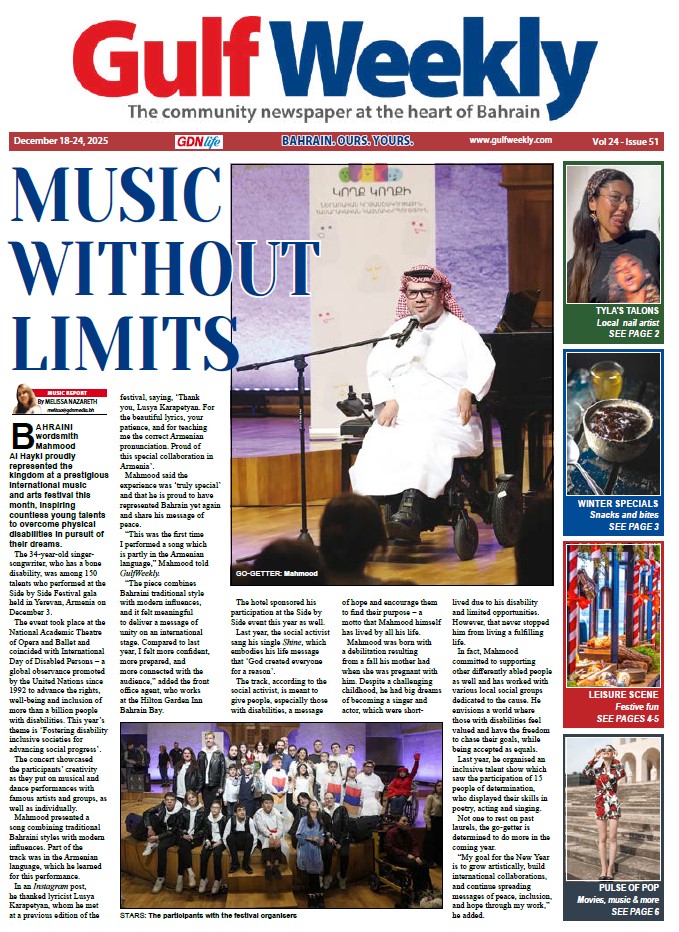
Turning out for a select Awali Taverners side, we played two matches last week against our opponents, the first a 10-over match where we played without blindfolds, and a shorter five-over game where we wore the covers over our eyes.
In the first match, our sure-sighted bunch won the toss and batted first. We made 71 runs in our 10 overs, with five pairs each getting two overs to perfect the sweep shot which is the most viable stroke in this form of the game.
Our score was chased down with relative ease as the World Champions, split up into three categories of B1, B2 and B3, made their 72 in 9.3 overs.
B1 refers to totally blind players, of which there must be four in the team. B2 players, of which there are three, are partially blind and can see up to three metres, while there must be four B3 players, who are partially-sighted and can see up to six metres.
B1 players, to balance out their impairment, score double on every run they attain, are allowed to take catches after one bounce and have to bowl 40 per cent of the overs in a match.
If we thought trying to score runs and take wickets was hard enough without blindfolds, it was nothing compared to the traumatic effort we conjured up when we put them on.
In a reversal of roles from the first game, our opponents walked out to bat first and made 45 runs, a healthy chunk of which came from Wides and No-Balls from our wayward bowling!
Our efforts at fielding were hilarious, often resembling someone groping around for the light switch in the dark, with the ball sailing past us and right through our legs as we chased the rattling noise.
When it was our turn to bat, the true appreciation for our opponents’ skills came to light. With our main sense taken away from us, we made a grand total of … six runs.
Six! And, whisper it quietly, five of those were Wides, so in actuality, we scored just one solitary run off the bat.
The routine of batting blind is to reach out and feel the stump so you know where to take your guard on the crease, before the bowler shouts “Batsman ready?” before every delivery. Then it’s a case of trusting your hearing and timing it right. But this isn’t a casual game of ‘bat the rat’ at the fairground, the ball comes fast and straight and the fielders know where the ball is going before you do.
Although I was extremely happy that I managed to get bat on ball in the three deliveries I faced, there was the strange sensation where I felt that everything was closer than it actually was, and that I’d hit the ball much further than I had. Despite feeling like I got a good connection, two of the balls I hit barely left the wicket, while the third was hit strongly but went straight to a fielder who gobbled it up and threw it back to the wicketkeeper with unnerving accuracy before I could even think to run.
Despite going by sound alone, the fielding was better than most you’d see on the village green on a Sunday, and numerous times in the first game we underestimated the arm of the fielders and were run out by an embarrassing distance.
After being thoroughly humbled and amazed, I spoke to captain Shekar Naik afterwards to get his story of how he rose up from being an outcast in a small village near Bangalore to be the leader of the national team.
He said: “I was born in 1986 and until 1994 I was 100 per cent blind, but after an operation I am now able to see about three metres in front of me. In my village, especially in the nineties, there weren’t many education opportunities and blind people were discriminated against.
“My mother hated the fact I was bullied. She wished that I would show these people that blind people can achieve something, and I made her proud by captaining India and representing my country. Everything I do is for her and I’m so happy to be fulfilling her dream.
“Coming to Bahrain has been a wonderful experience, even playing against normal cricketers; we can learn more things from them like style and expression. It’s the first time a blind team has been here and we’ve had great support, people have stopped their cars to meet us and the children have been extremely enthusiastic.
“There’s a blind school in Bahrain, so maybe in a few years we can come back and do some coaching for those children and maybe Bahrain can take a team to the World Cup.”
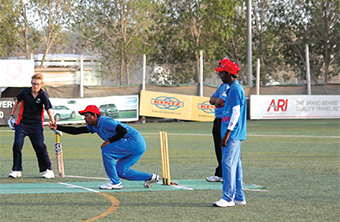
The team has since jetted off back to their homeland, but only after a joyous jaunt in the kingdom arranged by British expat business consultant David Axtell. The team visited the Indian Club and then St Christopher’s School, Sacred Heart School and the Bahrain Indian School where they met pupils and provided demonstrations, before playing matches against the Bahrain Youth Cricket Academy and BAPCO.
Mahantesh GK, founder managing trustee of the Samarthanam Trust for the Disabled and general secretary of the Cricket Association for the Blind in India (CABI), said that the visit to the kingdom had been a wonderful experience for the whole team.
He explained: “Bahrain is fantastic. The way the people have received us is amazing and the kind of love and affection shown by Bahrainis, Indians and other expats is really commendable.
“The interest shown towards blind cricket is remarkable. We did some demonstrations for the kids, and, of course, they were very curious. They are so innocent and they asked very direct questions with no holds barred, which is quite refreshing considering adults often skirt around the subject or try too hard to deliberately not bring up our visual impairments.”
Mahantesh started the trust in 1997, and in 2010 it focussed exclusively on managing cricket. Currently CABI manages coaching and each state in India runs zonal tournaments, where the best players are picked and invited to national tournaments. From here, 27 players are selected for intense training camps, where the final squad of 17 is selected.
He said: “Interest in blind cricket is picking up and has transformed the lives of the visually-impaired. Winning the World Cup has increased blind cricket fever worldwide, especially after our victory and our work for the blind was recognised by Prime Minister Narendra Modi.
“I’d like to say a big thank you to Mr Axtell and Gulf Air for getting us here; we’re so grateful for the experience and hope people have enjoyed having us here. We’d love to come back.”