






Indian expats in Bahrain will soon be able to transact locally with the Government of India-backed RuPay card, giving them a new and potentially cheaper way to send money home in Indian Rupees.
PM Modi made the announcement during his address at the National Stadium after a memorandum of understanding (MoU) was signed between the National Electronic Payments Network (Benefit) and the National Payments Corporation of India (NPCI) to discuss cooperation and link systems to facilitate payments between the two countries.
RuPay could turn out to be a significant player in the market, competing simultaneously with global card payments systems like Visa and MasterCard as well as international money transfer companies like Western Union and TransferWise.
The RuPay network, which is similar to China’s Union Pay domestic card network founded in 2002, was launched in 2012 to fulfil the Reserve Bank of India’s vision to have a domestic, open and multilateral system of payments.
In the past seven years, the card’s presence has grown exponentially in India, capturing nearly 50 per cent of the market share. It is backed by 10 leading banks in India, including several state banks and ICICI Bank.
The card has become emblematic of the Modi government and the Reserve Bank of India’s vision for greater financial inclusion, offering its services in rural, sub-urban and metropolitan areas.
This year, RuPay reported that it had processed one billion transactions, a nearly 70 per cent jump compared to 2018. RuPay is accepted at 97 per cent of Point of Service (PoS) terminals in India and offers transaction fees well below the market rates being offered by Visa and MasterCard.
The NPCI has also maintained an alliance with Discover Financial and JCB, to offer an international network where the RuPay card is accepted.
As opposed to most players in the market, RuPay is non-profit while still offering state-of-the-art technology that is secure, robust, scalable, simple and cost effective.
While there have been sporadic complaints about the network’s security and reliability, the feedback so far has been mostly positive due to its reach and lower fees, which can be as little as 45 paise (2.4fils).
In Bahrain, where the 400,000-strong Indian expat community regularly sends money home, the RuPay card could supplant money transfer companies if it is able to offer better services at a lower price.
In recent years, the network has expanded its offering to include credit cards, hybrid debit-credit cards and a Global card, enabling the acceptance of RuPay Global Cards to utilise the Discover, Diners Club International and PULSE networks for international purchases and cash access outside of India.
While it’s unclear if banks in Bahrain will be issuing the card, Indian expats who already have accounts at banks like State Bank of India and ICICI Bank as well as Indian tourists to the kingdom will likely be the first beneficiaries of the plan, offering them better exchange rates and a seamless customer service experience.
One significant hurdle the card still faces is that it is not accepted as a valid payment method by Google Pay and Samsung Pay, which may limit its adoption amongst customers who value contactless payments.
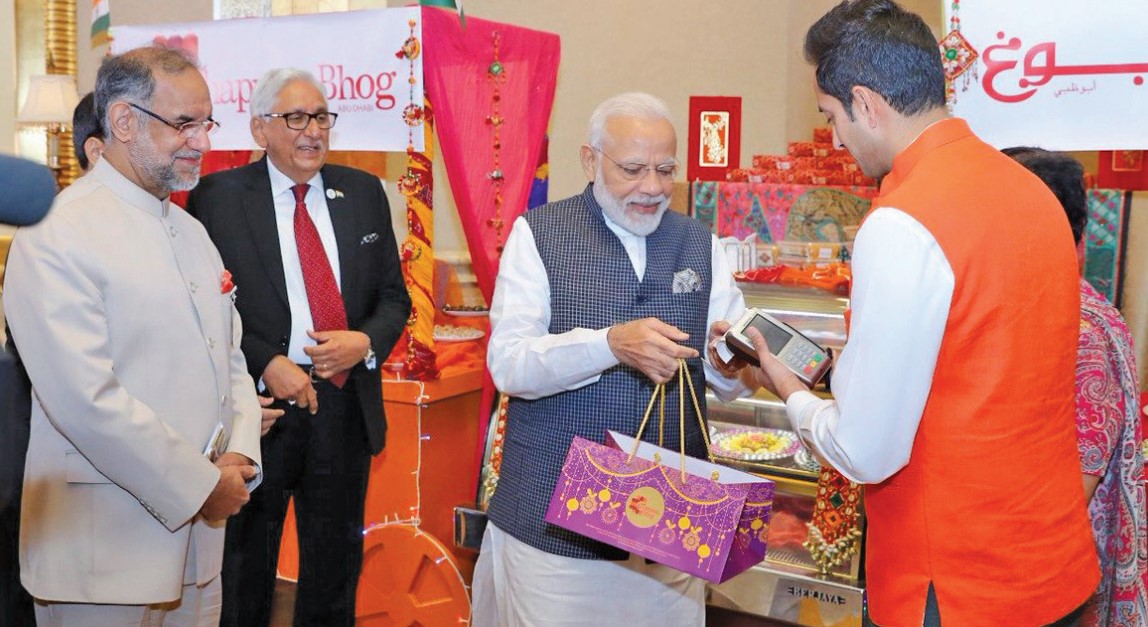
RuPay is already launched in Singapore, Bhutan and Maldives. It was also launched in UAE last week by PM Modi, who purchased a box of Indian sweets with the card while in the country, which he offered as ‘prasad’ at the temple in Manama, Bahrain.
Emirates NBD, Bank of Baroda and First Abu Dhabi Bank will start issuing the RuPay card there and RuPay will charge one-tenth the transaction fees levied by the big players in the market, as reported by Gulf News.
While a new player in a duopolistic market should inevitably lead to better prices for customers, it remains to be seen how a state-backed non-profit nationalistic payment network backed by the second-most populous country affects the local and regional payments market.

