





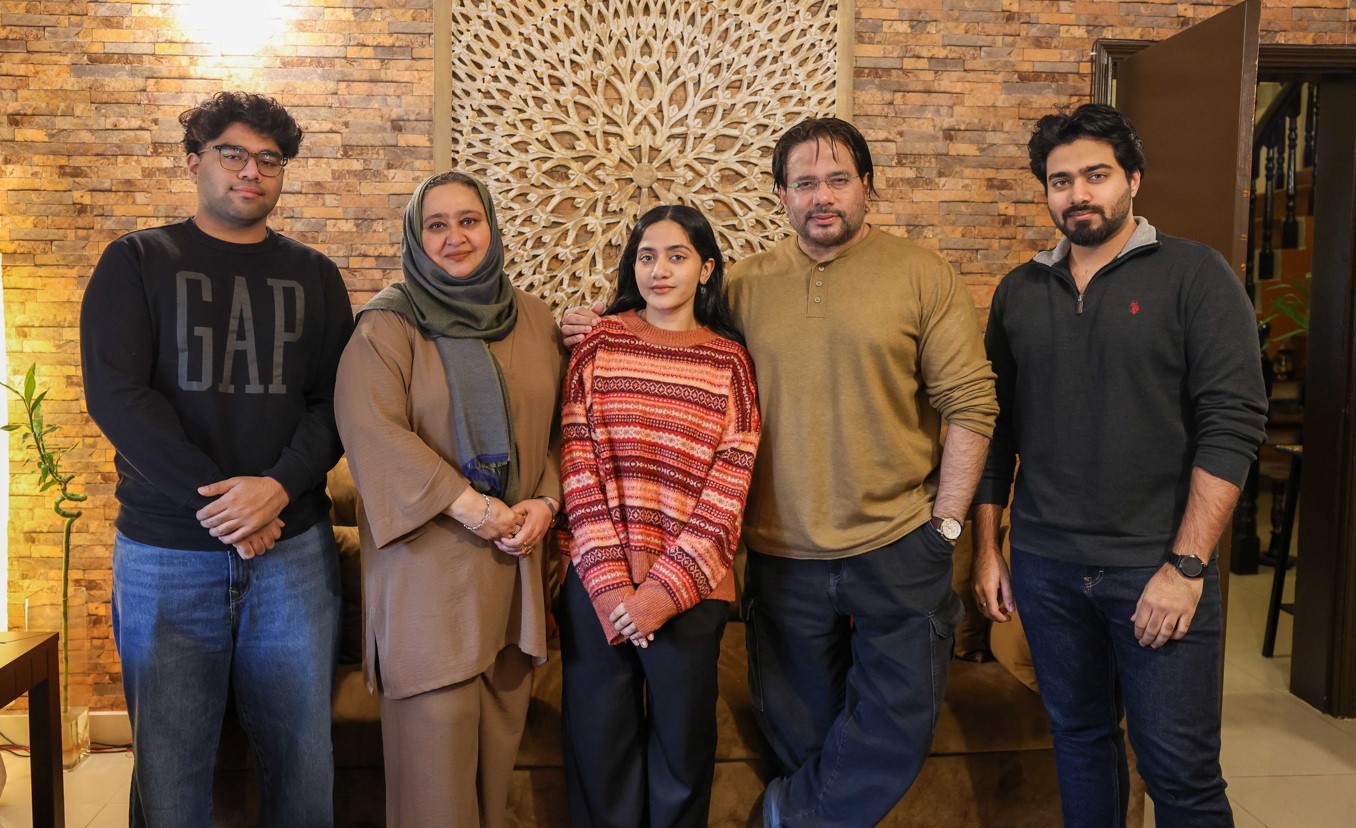
The Bahrain-based family of India’s most influential playback singer Mohammed Rafi opened their home to the GulfWeekly team, ahead of the musical maestro’s birth anniversary this month.
We spoke to grand-daughter Tasneem Firoz and grandson-in-law Firoz Ahmed about the man behind the ‘golden voice’ – a side that many do not know about. The couple also unveiled a selection of his personal belongings, sharing interesting anecdotes for some.
Also present during the interview, were their children Romaan Firoz, aged 27, who runs his start up, Fiza, 23, a graphic designer and Armaan, 22, who is currently pursuing a degree in electrical engineering from Northampton University in the UK.
Reverently called Rafi Sahib (‘sir’) by fans and colleagues, the decorated artist recorded as many as 7,000 songs during his illustrious career spanning four decades. In addition to numerous musical awards and recognitions, he was honoured with the Padma Shri in 1967 – one of India’s highest civilian honours. The creative talent sang in many languages, including Arabic, Sinhala and Dutch, as well as regional Indian languages. He has a diverse repertoire, which includes fast, peppy numbers and romantic tunes to distinct styles like qawwalis and ghazals, as well as melancholic melodies that could soften the hardest of hearts. While his voice had a unique quality, it could suit any actor’s persona, which added to his appeal. The singer celebrated his birth centenary on December 24 last year.
“One of my most precious memories of nana abba (a term of endearment by his grandchildren) was attending the preview of Karz, which features his song Dard-e-dil Dard-e-jigar,” Tasneem said, flipping through some of the notebooks containing handwritten songs from the sing er’s recordings.
“It was around my birthday, which is why I remember it so clearly and also because it was one of the last screenings that I attended with him before he passed,” the 53-year-old homemaker added.
Rafi died in July 1980 from a heart attack when he was just 55 years old. The funeral was one of the largest events in India with more than 10,000 people attending his burial. The Indian government even announced a two-day public mourning in his honour.
“It was a deep loss and I still tear up sometimes when I hear his songs. I was very close to him and he was particularly fond of me. Even though I had cousins from my uncles – his sons – our bond was different. He took me to his home from the hospital right after I was born and I spent a lot of time growing up at my grandparents’ house until I started school.
“Once, I saw one of our neighbours had a cycle with training wheels. I said in passing that I liked it and nana abba arranged for the cycle to be bought immediately even though it was really late in the evening.”
The Diraz resident, who moved to Bahrain with her family 12 years ago, noted that her grandfather was very family oriented and, when he was not recording, enjoyed spending time with them. However, he also enjoyed time alone and spent many an hour sat in his garden, sipping a cup of tea or meditating.
“The time he spent practicing his music was also behind closed doors or a curtained area and we were not allowed to go there. However, his voice resounded through the entire house.”
Rafi gave his first public performance when he was 13 years old. Though he was under the tutelage of prominent artists like Ustad Abdul Wahid Khan, Pandit Jiwan Lal Mattoo and Firoze Nizami, grandson-in-law Firoz said that it was more in the initial stage of his career.
“Later, he considered the composers he worked with as his ustads (teachers). ‘They are the ones who are teaching me the songs’, he used to say,” explained Firoz, who works as a global supply chain director.
“My father was a big fan of nana abba. He was a costume designer and so, I grew up around Bollywood film actors and talents, and have attended many of his live shows.
“Once we had hosted a dinner at our home and one of the guests was Pakistani ghazal singer Mehdi Hasan Khan Sahib, who is known as the ‘king of ghazals’. One of the guests said to him, ‘no one can sing ghazals like you in India’ to which he replied ‘it seems you have not listened to Rafi sahib’s ghazals’. I understood the depth of his response only when I got older.”
Scouring memories about the iconic vocalist, the 54-year-old highlighted his generosity and professionalism.’
“Even today, people who worked with him speak of his humility and punctuality. Many times, he reached before the recording and secretly helped people rehearse. Whenever, he entered a recording studio, it used to go silent. That is the aura he had.
“He gave so many new composers a break in the industry. In those days, if a music director wanted to enter the film industry, the producer expected him to get Rafi Sahib on board. And nana abba would oblige – free of cost,” he revealed, adding that the artist always liked to help people.
One other personality trait of Rafi that Firoz was all praises for was how he liked doing his own chores. He ironed his clothes and polished his shoes, he remarked, displaying a jacket that belonged to the maestro, which Firoz wears to this day.
Pointing to a burn mark, Tasneem said: “He burned it once while ironing it and after that would pin a rose there to hide the damaged part. He loved to dress up.”
The couple also spoke about Rafi’s honesty, noting that most artists back in the day did not do it mainly for the money rather to express the art that overflowed from within them.
“There was no Auto-Tune or Melodyne. There used to be an 80-piece orchestra and the singers and musicians had to practice because even if one musician went off, they would have to record the entire song right from the beginning. You seldom see that kind of honesty now,” Firoz added.
Even though the singer is no more, his legacy continues to inspire fans across generations and communities around the world. Firoz narrated how his Bahraini colleague told him about his love for Hindi films and songs specifying one particular personality.
“I thought he would name an actor but he said nana abba’s name. Eventually, when our mother visited us in Bahrain, I arranged for them to meet.
“Another Bahraini friend told me his uncle attended nana abba’s concert in Bahrain around the 70s. It was sold out but people were climbing up the fences just to get a glimpse. Nana abba being the generous man he was stopped singing and asked the organisers to open the doors so everyone could join and no one got hurt. He even offered to cover the cost for their tickets.”
Since then, several tribute concerts have been staged in Bahrain and across the world in honour of the artist.
“We get invited to many concerts and this month alone there are around 15 in various countries,” Firoz said, adding that the family now wishes to focus on making the singer’s legacy more accessible to fans around the world.
“I am active on Instagram (@firozahmed1221) and we try to connect with fans as much as possible.
“We try to attend more shows that are staged in honour of him.
“But what we always try to do is emphasise is his personal side – despite reaching the pinnacle of his career, he continued to remain compassionate and grounded and that is what we want people to also remember him by,” he added.

