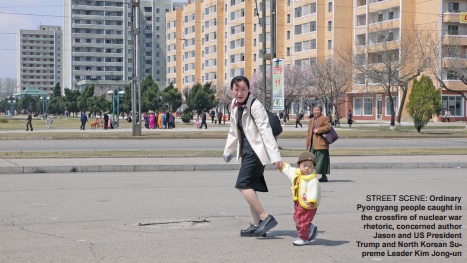
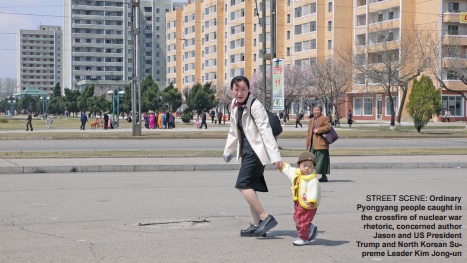
A Bahraini-based musician has opened up on his experiences in ultra-secretive North Korea as he prepares to publish his memoirs about a once-in-a-lifetime journey.
Jason Carter, who now lives in Janabiya, visited the Far Eastern country to perform at a music festival and believes that there is plenty of potential in the country but it is stifled by endless political posturing and bickering.
His urgings of diplomacy comes hot on the heels of growing unrest in the region and fear of military strikes between the US and North Korea including the chance of nuclear conflict.
North Korea, led by its Supreme Leader Kim Jong-un, continues to perform ballistic missile tests and work on a nuclear weapons programme despite United Nations sanctions as US President Donald Trump inflames the situation with posts on social media.
President Trump this week claimed US negotiators were being ‘made to look like fools’ and threatened ‘only one thing will work’. He tweeted: “Our country has been unsuccessfully dealing with North Korea for 25 years, giving billions of dollars and getting nothing. Policy didn’t work!”
Jason believes that the leaders on both sides need to swallow their pride and pursue a more civil path. He said: “The first principal is to understand the cultural differences. Asian culture is all about how you appear to be and showcasing a sense of pride. Most of the aggressive acts from Kim Jong-un are to bolster his position at home, in my opinion, and to ensure his people feel protected.
“Obviously, there are also some serious threats, but I don’t believe Kim Jong-un is stupid or indeed suicidal. He knows that if he starts something, North Korea would be destroyed almost instantly.
“However, what’s equally as unhelpful is the rhetoric spouted from the West. It’s like poking an angry dog with a stick. Why provoke him?
“International sanctions haven’t worked and shouting from a distance hasn’t worked, so maybe an official state visit is the way forward. Swallow your pride, put a delegation on a plane and try and get a dialogue going. Obviously, it wouldn’t be resolved straight away, but it would be a lot better than what we have now.”
Jason, 48, originally from the English county of Cornwall, has travelled to more than 100 countries around the world, performing his harp guitar and classical guitar pieces.
It was during October 2006, whilst in Singapore working for the British Council, that North Korea conducted its first nuclear test.
Jason was in his apartment at the time, watching the news on TV. The images grabbed his attention and he turned up the volume as the usual images of military parades through the streets piqued his interest.
Believing there must be more to the country than endless military posturing, he sent an email at 3am to the British Ambassador to North Korea, John Everard, saying he was a musician and was interested in collaborating with North Korea.
He received a reply the next day, with a thanks for his ‘unusual request’ but the British government could not be seen to be officially supporting the regime.
However, Jason’s CV was forwarded to the Foreign Office in London and the British Embassy in Pyongyang, North Korea’s capital.
Two months later, he received a call from a strange number and assumed it was one of his friends he had made from around the world. However, it turned out to be the North Korean Embassy in London, inviting him to discuss a possible visit to perform as part of the country’s 2007 April Spring Festival.
Jason explained: “I went to the embassy, which was a small terraced house in London, very low-key. The ambassador was stern at first, but he started cracking jokes about North Korea and his own country. He was very self-aware about the perceptions of his country.
“After three visits, innumerable background checks and having to get permission through the longest hierarchy chain I’ve ever encountered, I was granted a visa.
“I had to make my own way to China. At the time, there were two flights to North Korea from Beijing every week, and one flight from Russia.
“In Beijing, the airline gave me a boarding card to Pyongyang and said I’d receive my return ticket when I got there. Let me tell you, going to North Korea on a one-way ticket was the scariest experience of my life!”
Jason believes he was a little naïve. He was aware that he was being used as propaganda, but not to the extent that a film crew would follow almost his every move.
When he arrived, his passport and mobile phone were confiscated at the airport. Other artists to perform arrived with him, but were all escorted away separately and they weren’t allowed to mingle. Jason was taken to a hotel, and his only company was a guide, a translator, and North Korean soldiers who shadowed him. He had no phone and no Internet in the room.
The main purpose of his visit was to perform in the 3,000-seater Pyongyang opera house for five nights as part of the festival, held every April to celebrate the birthday of Kim Il-sung, grandfather of Kim Jong-un and the founder and former president of North Korea.
Jason’s musical skills, which he developed in diverse locations such as Afghanistan, Uzbekistan, Pakistan and the Gulf States, have garnered him a reputation for being an ‘ambassador for peace and intercultural dialogue’.
He has also received honours and awards as well as support from UNESCO, The United Nations and the British Government for using his musicianship to bridge cultural gaps.
Despite this, when Jason first arrived, he was told that he couldn’t play the music he’d suggested, which is completely non-threatening, because it wasn’t traditional folklore music and officials thought there could be hidden messages contained within.
After a lot of argument, the names of his pieces were changed and he wasn’t allowed to speak to the audience at all, which was a considerable challenge to Jason as he loves close contact with his audiences. He also couldn’t speak to the other artists but instead watched them on the country’s one TV channel.
However, despite these considerable challenges, he believes the experience was incredibly rewarding. He said: “Those moments on stage where I performed to 15,000 North Koreans was nothing less than a privilege. For perhaps the only time I was there, I was free.
“The atmosphere was stale and controlled, and you almost couldn’t breathe. But, to sit and introduce music, to breathe music into a place like that, completely changes the dynamic.
“I’m under no illusions that my music would change people or bring forth a radical shift, but it might challenge their perspective. Hardly any Westerners visit the country, so to see a Western guy with long hair, with a Spanish guitar and dressed differently challenges their perspective on what the world is.
“Music engages imagination and a creative spark. If even one of those people who saw me went home and played guitar differently, I’ve sowed a seed and brought a bit of colour to what is the most rigid of practices.”
Outside of his performing, Jason spent much of his time either going on excursions, accompanied by his delegation, or in the lounge of the hotel. Most outside visits consisted of sightseeing at different statues and landmarks. The most bizarre one was a trip to a warehouse filled with gifts that has been given to Kim Il-sung and Kim Jong-il from admirers. They included everything from operational helicopters to tiny trinkets.
Jason was allowed to take photographs of whatever he liked, except soldiers and government buildings. Unfortunately, as he was in Pyongyang there was a high density of these, so his guide directed him where best to shoot.
He said: “I was surprised by how friendly and lenient they were. Apart from the obvious stuff, they didn’t seem to mind what I took photos of. I took hundreds, and although every night they went through my camera and deleted what they didn’t like, they weren’t that strict.”
During his long hours in the hotel, he started penning a diary of his North Korean stay. Afterwards, he rewrote it as a chronological story, with the idea of using it as part of a wider project about how music can build bridges.
However, he realised that experiencing something as random and bizarre as North Korea needed a book of its own.
He named it: The Colour of Silence: 10 Days in North Korea, but only released it in audiobook form after a friend did the recording, with the idea to release it as a printed publication in the future.
With North Korea being so prominent in the news this year, Jason finally decided the time was right, seeking a proper release complete with the full colour pictures that he took. It is currently undergoing proof-reading and will be ready for purchase soon.