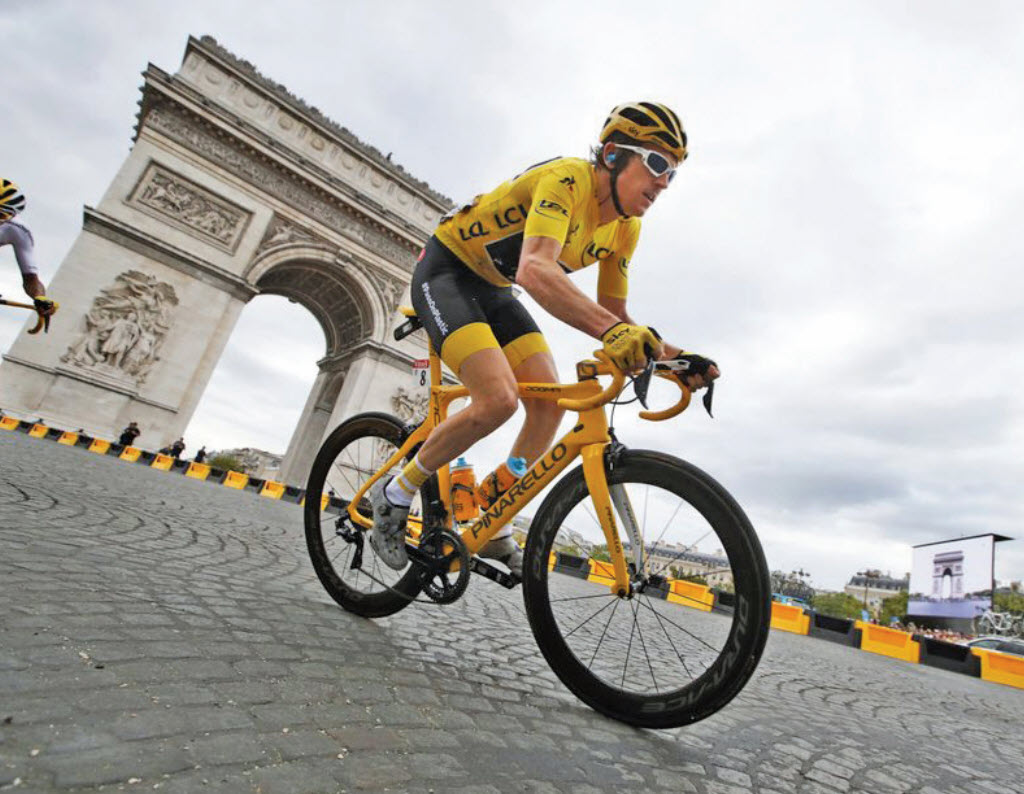
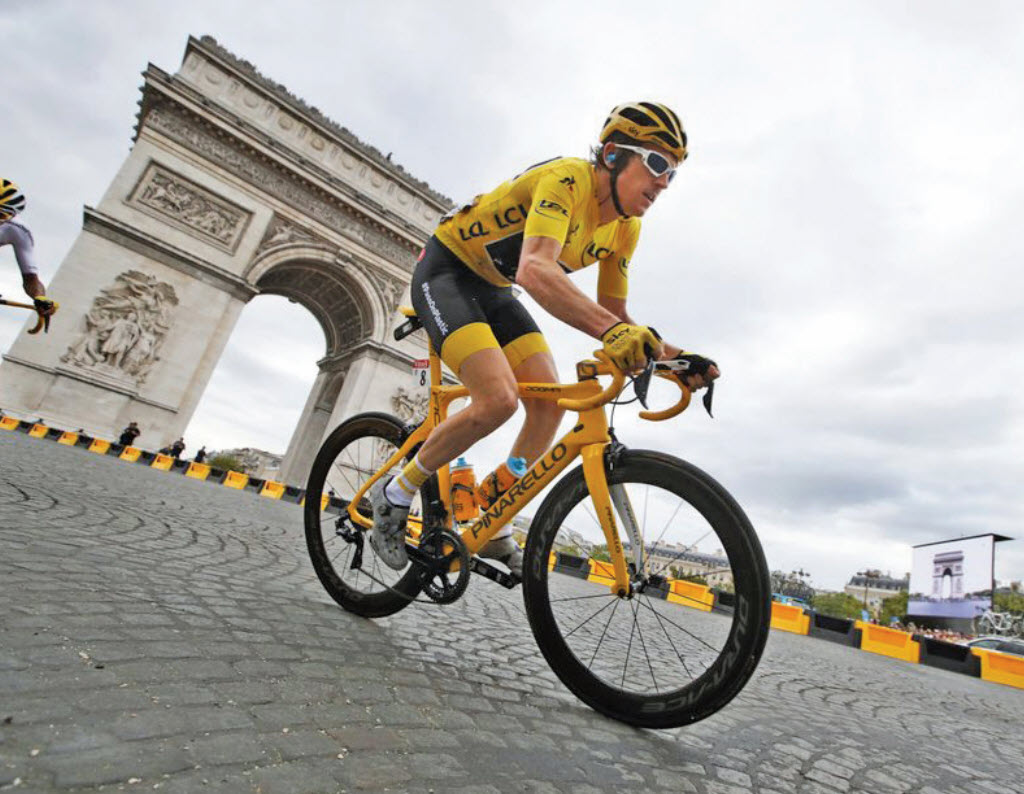
AS three exciting weeks drew to a close on the Champs-Elysees in Paris on Sunday, Geraint Thomas celebrated his first Tour de France title. The lap of honour on the splendorous boulevard is the reward for three weeks of hard work … because the path to get there is hard, rocky and hilly.
But it wasn’t the cobblestones of the north, the shimmering heat of the south, the steep climbs of the Alps and Pyrenees, or even attacks from his opponents that were the hardest tests that Thomas faced over these past three weeks.
Instead, it was being booed, spat at, sprayed with tear gas (inadvertently by the police) and even a physical attack by a fan that almost pulled him off his bike.
What a Tour for Geraint Thomas!
“Obviously it’s not good and I won’t be riding quite so close to the barriers,” said Thomas, who admitted he did not appreciate how serious the incident on Stage 17 was until much later. “I could have quite easily fallen and lost a bit of time. I was going quite fast past him but it certainly moved me off my line. It was a bit of a shock but luckily I was OK.
“Obviously it wasn’t nice. We come here to race our bikes and that’s all we want to do. The whole peloton just wants to do that safely. It’s a bit too much.”
The 32-year-old, who is known to his friends and fans alike simply as ‘G’, is a very unpopular winner of the Tour de France. But why is that?
For many French cycling fans the answer is simple: It’s because Geraint Thomas is a teammate of Chris Froome and part of the unpopular British Team Sky. On the surface, the mistrust is understandable due to the various questions that have come to light in recent years.
With its dubious drug deliveries, a series of medical exemptions and particularly the Salbutamol affair surrounding Froome, Sky hasn’t helped cycling’s image as a clean sport.
Froome was only cleared to race the week before the Tour started, after his anti-doping case was dropped by cycling’s world governing body, the UCI.
The 33-year-old was under investigation after more than the permitted level of legal asthma drug Salbutamol was found in his urine during his Vuelta a Espana victory.
The debate whether Froome should have been allowed to compete or not is one for another time, but the fact remains that outside of Britain, he and by extension Team Sky, remain deeply unpopular.
But none of this is Thomas’ fault. The two-time Olympic champion, already an OBE, is a brilliant all-rounder, who gradually moved up the pecking order thanks to years of consistent performances in Froome’s shadow. And, on this Tour, he was simply the best.
Sure, Thomas is a close friend of Froome and has been his most faithful companion. But in cycling, as elsewhere, one should not be found guilty by association. Currently there is no incriminating evidence against the heir to Froome’s throne, and until some is provided, he must be regarded as innocent. He deserves all of the respect that goes along with winning the hardest cycling race in the world.
However, one thing should not be overlooked. Strategically speaking, Thomas is exactly the right winner of this Tour de France from the perspective of his Sky team. The team with an annual budget of around £40m (around BD20m) is way ahead of the competition financially and has been dominating the competition for years, with six out of the last seven victories now.
However, a Froome win may have brought more derision and unease, whereas Thomas is often said to be one of the nicest guys on the Tour. Therefore, despite the controversy, there’s a feel-good factor in the air.
There was a time when Thomas appeared to be blessed with talent but cursed by the rider it made him. A rider described by Team Sky boss Sir Dave Brailsford as one who could do everything, a racer who seemed destined instead to ride for others, who kept crashing when openings came.
Down on the final descent of the Olympic road race in 2016, down twice at the Tour de France in 2017, down when in wonderful form at the Giro d’Italia the same year.
Now that curse is gone, blown away over the past three weeks in relentless and spectacular fashion. In its place, a certain giddiness, a happy disbelief, a triumph bigger than any of those disappointments combined.
Thomas watched his old Great Britain team-mate Bradley Wiggins win the 2012 Tour de France. He helped Froome to the podium in Paris three times, once having ridden for 20 days with a fractured pelvis. He has stood aside so Froome could chase other Grand Tours that Thomas might otherwise have won.
At an age when riders start looking over their shoulder at younger, fresher talents, Thomas’ reward has come.
And when he stood on the Champs-Elysees on Sunday evening, blinking at the hundreds of photographers and thousands of fellow Welshmen who had travelled to witness the coronation, his happiness was shared far beyond.