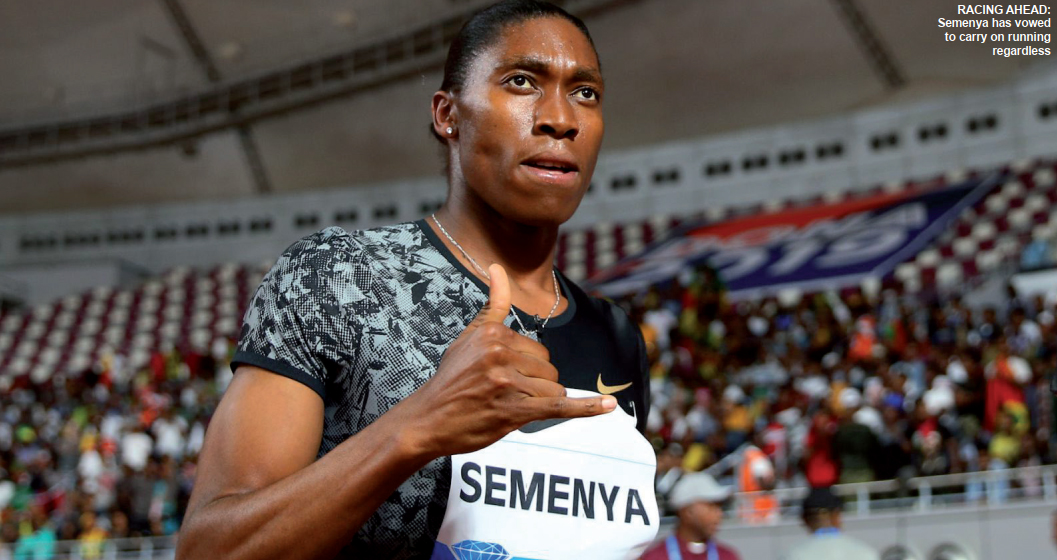
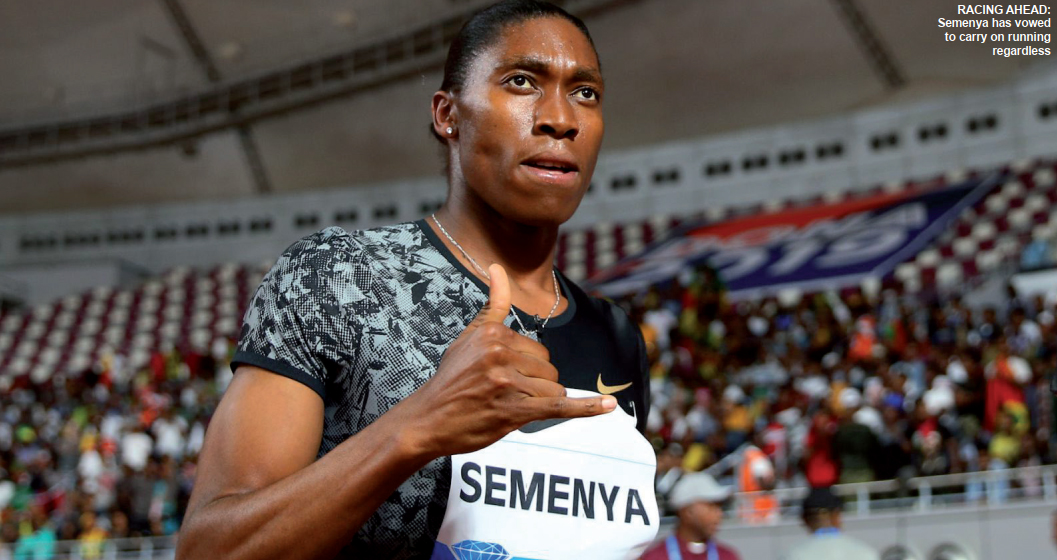
Caster Semenya has lost a landmark case against athletics’ governing body meaning it will be allowed to restrict testosterone levels in female runners.
The Court of Arbitration for Sport (Cas) rejected the South African’s challenge against the new rules enforced by the International Association of Athletics (IAAF).
The Semenya case began acrimoniously and ended the same way. It started with a search for a simple truth yet even in its resolution leaves loose threads and unanswered questions. The final verdict protects the rights of many sportspeople, and leaves other heroes ostracised and exposed.
Nobody has truly won. One side has just lost less than the other.
For Semenya, Olympic champion over 800m, a private life lived publicly has now brought both an unwanted notoriety and what appears the cruellest of choices: undertake radical hormone therapy, or step away from the sport that has defined her life and taken her from rural poverty to the status of national icon.
It took three arbitrators more than two months to reach their decision.
When they did, only two of them accepted the argument and the policy that came from it: that high testosterone in female athletes confers significant advantages in size, strength and power from puberty onwards and that the rules were ‘necessary, reasonable and proportionate’ to ensure fair competition in women’s sport.
Semenya is an easy woman to defend, an inadvertent global cause that few cannot find immense sympathy for.
She is not the only female athlete with differences in sexual development (DSD) in her event, let alone her sport. When she brought her case to Cas, claiming discrimination, her statement was defiant: “I am Mokgadi Caster Semenya. I am a woman and I am fast.”
Semenya has done absolutely nothing wrong. She was born with her condition, raised as a woman and continues to identify as a woman. Her high levels of testosterone are naturally occurring. She was beaten at the 2012 London Olympics only by a Russian who has now been banned for doping.
Now, if she wishes to compete at September’s World Championships in Doha, she will have to take a blood test for her eligibility and then start taking medication within one week.
You would wish that on no-one. Sport is about elite excellence but also about inclusivity. It is about being as good as you can biologically be, about bringing together different nations, creeds and physiques.
The IAAF’s near-impossible conflict has been in protecting all those ideals, but also the rights of women who Semenya – and other athletes with DSD – have been not just routinely beating but leaving far in their wake.
Controversy has followed Semenya from the start. She arrived at the 2009 Worlds in Berlin as a muscular, deep-voiced 18-year-old who had improved her 800m personal best by seven seconds in less than nine months, and then ran away from her rivals to take gold by the biggest margin in championship history.
Inside athletics, coaches and athletes have always talked. Was she winning without having to train as hard as her rivals? Could she run a poor tactical race and still come out on top? Did she ever have to push herself to her limits as others did?
The argument on one side was simple.
Men with longer limbs benefit from a significant edge in basketball.
Sprinters with a higher proportion of fast-twitch fibres are at an advantage over other men without the same natural speed.
It was also simplistic. Elite basketball is not divided into categories for those of different height. The 100m at the Olympics is not split along lines of muscle fibre.
At the Olympics you can compete only as a man or a woman. And, if 99 per cent of female competitors are significantly disadvantaged against intersex athletes with hyperandrogenism, should they not be protected too?
The IAAF says that most female athletes have testosterone levels in the range of 0.12 to 1.79 nanomoles per litre (nmol/l). DSD athletes are usually in the normal adult male range, from 7.7 to 29.4nmol/l. The International Olympic Committee states 99 per cent of women have testosterone levels less than 3.0nmol/l.
That is not comparable to American swimmer Michael Phelps’ much-discussed natural advantages. Most adult males have a wingspan close to their height. Phelps is 6ft 4in with a wingspan of 6ft 7in.
The IAAF has also not said DSD athletes cannot compete. Under its guidelines they can, but if they wish to compete in women’s events, they must reduce their testosterone to below 5nmol/l for at least six months in some events.
However, it will not solve the argument that is brewing into a storm around the rights and restrictions surrounding transgender athletes in women’s events. Neither will it change the minds of those who see Semenya as a victim rather than accidental biological bully.
The simple fact, however, is that no young women are going to want to become a 800m runner for the next decade because they’ll be competing against someone with a naturally unfair advantage. This kills the sport both from a participation and audience standpoint. If there is no competition on track, who wants to watch it?
The ‘basketball argument’ as mentioned above has come up numerous times this week, but is it really comparable? You’re always going to have taller people on the court, but you can make up for height deficiencies with technical skill, dribbling, throwing accuracy and more.
In athletics, it’s about pure speed and muscle which is dictated by your genetic make-up. You can’t just compensate for that in other areas like you can in ball or racquet games.
It’s an impossible situation. Both sides are right and both sides are wrong. And, in the middle of it all, completely innocent, is a poor woman who just wants to be seen as such while running as fast as she can.
Her proud response stated: “I know that the IAAF’s regulations have always targeted me specifically. For a decade the IAAF has tried to slow me down, but this has actually made me stronger. The decision of the CAS will not hold me back. I will once again rise above and continue to inspire young women and athletes in South Africa and around the world.
“They laugh at me because I am different. I laugh at them because they are the same.”