This week I will highlight the methods and tests for diagnosing Parkinson’s disease. It follows my article last week about the features and symptoms of the condition. To summarise, it is a movement disorder characterised by slowness and shakes. It is a progressive disorder and early diagnosis is important to treat and establish a future plan.
Making an accurate diagnosis of Parkinson’s disease, especially in its early stages, is difficult, but a skilled physician can come to a reasoned conclusion that it is Parkinson’s. It might not be easy, and take years to come to a conclusion in the early stages of the disease, as the symptoms might not be evident enough to support this conclusion.
Often, the diagnosis of Parkinson’s is first made by an internist or family physician. A second opinion can be obtained from a neurologist or a geriatrician – for patients 65 or older.
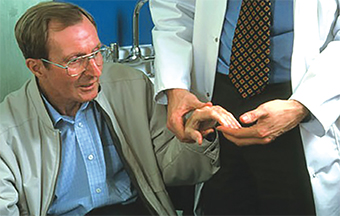
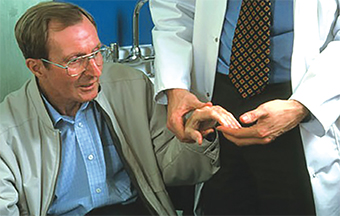
To diagnose Parkinson’s, the physician takes a careful neurological history and performs a thorough physical examination. The diagnosis of Parkinson’s disease is clinical (relies solely on history and physical examination).
Your doctor will look to see if your expression is animated and if your arms are observed for tremor. They will also assess if there is stiffness in your limbs and whether you can rise from a chair easily. Your walking will also be assessed; the doctor will look for slowness and unbalanced walking. Certain scales can also guide the diagnosis, this includes the United Parkinson’s Disease Rating Scale, which your doctor might perform.
Other tests including blood tests and brain imaging are generally done to exclude other causes of shakes or stiffness such as a stroke. A nuclear (x-ray) PET scan can be used to also look at the chemical imbalance in the brain and assist the diagnosis of Parkinson’s disease.
Scientists are working currently on a blood test or a biomarker that can assist in the diagnosis too. The diagnosis can be difficult to make especially at the early stages of the diseases and a second expert opinion is usually requested.
Next week, I will look at the medicines used in treating the disease.