






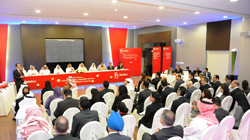
The Batelco Group delivered steady year-on-year gross revenues for 2010 of BD340.3 million ($902.7 million) and net profit of BD86.8 million ($230.2 million), a decline of 17.4 per cent over 2009, it was revealed at the annual general meeting held at Batelco headquarters in Hamala.
The board of directors' recommendation of a total cash dividend of 45 fils per share for 2010 amounting to BD64.8 million ($171.9 million), representing 45 per cent of the paid-up capital, was approved at the AGM. Batelco paid 20 fils per share as the interim dividend in July 2010 and the remaining 25 fils per share will be paid in March 2011.
Batelco chairman Shaikh Hamad bin Abdulla Al Khalifa said that Batelco's steady revenues were delivered in spite of the continuing impact of declining market share in Bahrain caused by increased competition and regulatory decisions which have limited Batelco's growth in a heavily saturated market.
"In addition to the reduced market share, Batelco Group's annual financial results were affected by its share of expected losses for its start-up operation S Tel (India), which completed its first full year of operation in 2010," he said.
"Our strategy to grow and diversify the group through our expansion programme continues to be successful and resulted in a 67 per cent increase in Batelco's customer base, which reached an impressive 9.2 million across the group's seven operating markets by the end of 2010," Shaikh Hamad added.
Batelco Group chief executive Peter Kaliaropoulos said that Batelco's solid financial and operating results were delivered in undoubtedly the most challenging year for Batelco in the last decade.
"In spite of the challenges, we further diversified during 2010 and grew our business to over 9.2 million customers by the end of the year. We retained market leadership in Bahrain, Kuwait and Yemen. In Jordan we achieved almost equal second spot in the mobile market share whilst in India and Saudi Arabia, we achieved above expectations results after the first full 12 months of operations in the most competitive of market places.
"However, the entrance of the third mobile operator in Bahrain has had a marked impact on the highly-penetrated telecoms industry and Batelco's operation in Bahrain. Additionally, establishing our Indian operation also affected our financial performance as such a start up venture is not expected to break even till 2014."
Mr Kaliaropoulos said that Batelco's operating profit for 2010 of BD106.5 million ($282.5 million) declined by 4.7 per cent compared to the previous year.
"Whilst Batelco Bahrain's operating profit was lower, stronger year-on-year results from Umniah reduced the overall decline in operating profit. Batelco's overseas operations contributed 34 per cent of gross revenues and 25 per cent of EBITDA. Group free cashflow of BD109 million ($289 million), representing a 75 per cent EBITDA conversion rate, exceeded expectations.
"Our net profit of BD86.8 million ($230.2 million), a 17.4 per cent decline versus 2009, included our share of S Tel's first year losses and the end of Sabafon's investment tax exemption in Yemen, a total of BD13 million adverse impact," he said.
Looking forward, Mr Kaliaropoulos added that growing the group's operations overseas and also growing customer numbers continued to be strategic priorities for Batelco.
"Retaining our leadership in the Bahrain market is also of key importance. We are committed to delivering a full range of communication services, world-leading products and unmatched customer care and in 2010 invested BD22 million ($58 million) in new wireless and fixed infrastructure in Bahrain.
"In order to operate more efficiently and reduce our input costs we are leveraging our resources further to 'deliver more with less' through process re-engineering and innovation. To that end we will continue to make our back office systems and processes 'smarter' across the group and continue to implement cost reduction programmes and restructure our operations driven by market conditions. Additionally, by reviewing procurement arrangements with our largest suppliers on a group-wide basis, we are striving to improve supply terms and service delivery," Mr Kaliaropoulos explained.


